How to Tell If a Ring Is Too Big
Table of Contents
- Signs Your Ring Is Too Big
- The Spinning Test and What It Really Means
- How to Measure Ring Size at Home
- Why Ring Fit Changes Throughout the Day
- Ring Adjusters for Loose Rings
- How to Resize a Ring Professionally
- Long-Term Risks of Wearing a Loose Ring
- Frequently Asked Questions
Last Updated: September 26, 2026
Signs Your Ring Is Too Big
Learning how to tell if a ring is too big helps you identify one of the most common fitting problems people face. Early detection prevents damage and frustration.
The clearest sign your ring is too big is excessive spinning and rotation around your finger. If it twists freely or rotates completely around your finger, there's too much space between the band and your finger at the base.
Another obvious indicator is visible gaps between the band and your skin. If you can fit a thin object like a piece of paper under the band, your ring is too big.
A third sign is difficulty keeping the ring in place. If it slides down when you raise your hand or move your fingers, the sizing is off.
A ring that slips off entirely, especially in cold or wet conditions, is the most urgent sign that resizing is needed.
Excessive spinning and rotation
When your ring spins freely on your finger, rotation happens because the band has too much diameter relative to your finger.
Test this by gently trying to rotate your ring. If it rotates more than a quarter turn without resistance, it's too big.
Spinning can cause the setting to catch on clothing, bend prongs, and damage delicate bands over time.
Visible gaps between band and finger
A gap between the band and the base of your finger is the clearest visual sign of poor fit.
Try the light test: hold your hand up to a window or lamp. If light shows through between the band and your finger, there's too much space.
Gaps allow dirt and debris to collect under the ring, causing skin irritation and making cleaning more difficult.
Difficulty keeping the ring in place
A ring that requires constant adjustment is too big. This constant movement means the band is sliding down past the widest part of your finger.
If sliding happens consistently throughout the day, the base size is wrong.
The Spinning Test and What It Really Means
The spinning test is the quickest and most reliable at-home method for how to tell if a ring is too big.
A properly fitted ring should have friction at the base of your finger. If it spins freely or completes a full rotation without effort, there's too much space.
To perform the test, place your ring on your finger and try to rotate it gently. A well-fitted ring will move slightly but stop before completing a full turn. A too-big ring will spin completely around your finger.
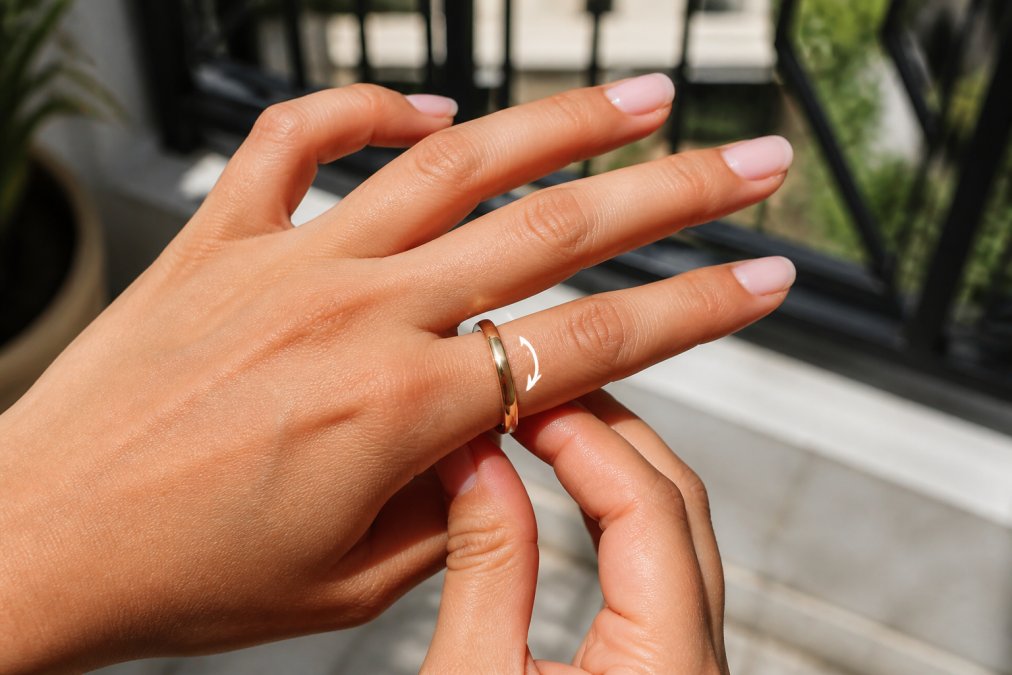
The spinning test works best combined with other checks, since temperature and time of day affect finger size.
If your ring spins and you also see visible gaps, or if it spins and slides down your finger, you definitely need to resize.
Don't confuse the spinning test with normal movement. A ring that rotates a quarter turn is normal. A ring that spins fully around is too big.
How to Measure Ring Size at Home
Accurate home measurement can help you understand your sizing problem and guide your next steps.
Using a ring sizer or string method
The most accurate home method uses a piece of string or a ring sizer tool to measure the circumference of your finger.
If using string, wrap it around the base of your finger where the ring normally sits. Mark where it overlaps, then measure in millimetres. A circumference of 46-47mm typically equals a size L or M in UK sizing.
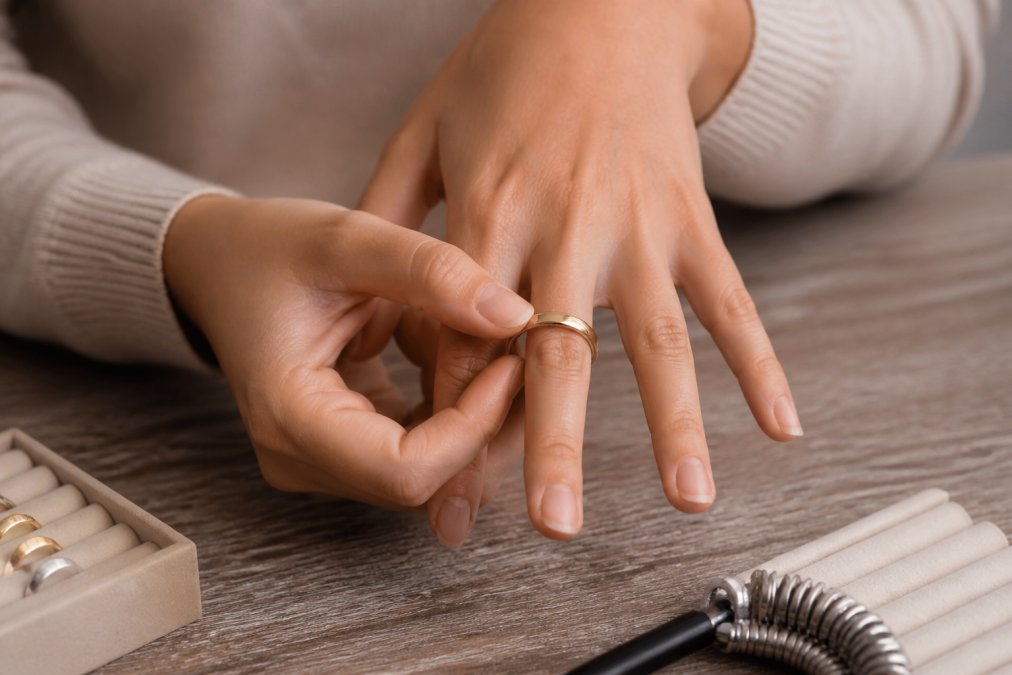
A ring sizer is a plastic or metal tool with graduated holes. Slide your finger through until you find the snug fit. The number on that hole is your ring size.
Measure at the base of your finger, not at the knuckle, which is wider.
Accounting for finger swelling and temperature
Your finger size changes throughout the day and in response to temperature, which affects ring fit.
Fingers swell in warm weather and after activity, and shrink in cold. Morning is typically when fingers are smallest. If your ring fits perfectly in the morning but slides off in the afternoon, you might not have a permanent sizing problem.
Measure your finger at different times and temperatures. If measurements vary by half a size or more, temperature and swelling are affecting your fit.
If variation is significant, a ring guard or sizing bead might be better than permanent resizing.
Why Ring Fit Changes Throughout the Day
Finger size naturally fluctuates based on blood flow, physical activity, sodium intake, and hormonal changes.
Fingers are smallest in the morning and largest in the evening. For most people, this variation doesn't significantly affect ring fit.
If variation is large, a ring that fits in the morning might slide off in the afternoon. Temporary adjustments or careful sizing decisions become important.
Cold also shrinks fingers noticeably. Winter months often bring sizing challenges. Some people need different ring sizes for summer and winter, though this is less common.
Track your finger size over several days and weeks. This gives you a realistic picture of how much variation you experience. Use this information to decide whether your ring is genuinely too big or whether you're dealing with normal fluctuation.
Ring Adjusters for Loose Rings
If your ring is too big but you're not ready for permanent resizing, several temporary and semi-permanent solutions exist. These adjusters can extend the life of a ring while you decide on your next steps.
Sizing beads and spring inserts
Sizing beads are small metal beads soldered inside the ring band. They reduce the inner diameter slightly, taking up space without removing metal. A jeweller adds one or more beads depending on how much sizing is needed.
Sizing beads work well for rings that are slightly too big. They're less effective if the ring is significantly oversized. The beads are permanent once installed, but they can be removed if needed. This makes them a good middle ground between temporary solutions and full resizing.
Spring inserts are flexible metal bands that fit inside the ring. They grip your finger and prevent the ring from sliding. Unlike sizing beads, spring inserts are removable and adjustable. You can take them out when you want to wear the ring without the insert.
Spring inserts work best for rings that are only slightly loose. They're visible from the inside of the ring, so they're not ideal if you want a completely seamless look. However, they're affordable and reversible, making them popular for borrowed rings or temporary situations.
Ring guards and temporary solutions
Ring guards are rubber or silicone bands that fit around the outside of the ring. They increase friction against your skin, preventing the ring from sliding. Guards are the cheapest and quickest solution, though they're also the most temporary.
Ring guards work for rings that are only slightly too big. They won't help if your ring spins freely or slides off completely. Guards also change the appearance of the ring, which matters if you care about aesthetics.
You can also use clear tape or adhesive bandages as a temporary fix. Wrap a small amount of tape around the inside of the band to increase friction. This is a quick solution for an evening out or a special event, but it's not suitable for daily wear.
Another temporary option is wearing the ring on a different finger. Not all fingers are the same size.
How to Resize a Ring Professionally
Professional resizing is the most reliable solution for a ring that's too big. A skilled jeweller can adjust the band to fit perfectly.
When to see a jeweller
You should see a jeweller if your ring is significantly too big, if temporary solutions aren't working, or if you want a permanent fix. A jeweller can assess the ring and recommend the best resizing approach.
What happens during professional resizing
The jeweller will clean your ring and assess its current size and condition. They'll discuss your desired size and how much adjustment is needed. For most rings, resizing involves cutting the band, removing or adding metal, and soldering the band back together.
Long-Term Risks of Wearing a Loose Ring
Wearing a ring that's too big carries real risks beyond simple inconvenience. Understanding these dangers helps you prioritize getting a proper fit.
Frequently Asked Questions
Is it bad to wear a ring that is slightly too big?
Yes. A loose ring can slide off unexpectedly, especially during daily activities like exercise or washing hands. Over time, constant friction and movement may cause indentations on your finger and increase the risk of losing the ring entirely. If your ring spins freely or shows visible gaps at the base of your finger, professional resizing or a temporary adjustment is worth considering to protect both your ring and your comfort.
How do I measure ring size at home accurately?
Use a piece of string or paper to wrap around the base of your finger where the ring should sit. Mark where the ends meet, then measure the length in millimetres. Consult a ring size chart to find your corresponding size. Measure in the evening when your finger is slightly swollen, and avoid measuring immediately after exercise or in cold temperatures, as these affect finger size.
What's the difference between ring adjusters and professional resizing?
Ring adjusters, such as sizing beads or spring inserts, are temporary solutions that add friction to prevent spinning and sliding. They work well for minor looseness but don't change the actual ring size. Professional resizing involves a jeweller physically altering the band to reduce its diameter permanently. For engagement rings with settings and prongs, or rings made from delicate materials, professional resizing is safer and more durable than DIY fixes.
Why does my ring fit differently on different days?
Finger swelling varies throughout the day and with temperature fluctuations. Heat causes blood vessels to expand, making fingers slightly larger, while cold has the opposite effect. Time of day, exercise, salt intake, and hormonal changes also affect how snug or loose a ring feels. A ring that fits perfectly in the morning may spin by evening. This is why measuring at consistent times and accounting for natural swelling patterns is crucial when determining your true ring size.