

How to Measure Ring Size at Home: Full Guide
Table of Contents
- What You'll Need Before You Measure Ring Size at Home
- How to Measure Ring Size with String (Step-by-Step)
- Measuring an Existing Ring for Size
- UK Ring Size Chart: Circumference, Diameter, and Conversions
- Average Ring Size for Women in the UK and What Affects It
- Tips to Measure Ring Size at Home Accurately
- Conclusion
Last Updated: August 16, 2026
What You'll Need Before You Measure Ring Size at Home
Getting your ring size right the first time saves frustration when ordering online. Learning how to measure ring size at home is straightforward and requires only items you likely already own.
Here is what to gather:
- A thin strip of paper or non-stretchy string (roughly 15 cm long)
- A fine-tipped pen or marker
- A ruler with millimetre markings
- A pair of scissors (optional)
- Access to a printer if you plan to use a printable ring size chart
Avoid stretchy thread, elastic, or thick twine, these compress or expand under tension and give inaccurate readings. A narrow strip of A4 paper is the most reliable DIY option because it holds its shape and marks precisely.
Measure at the right time of day for accuracy. Fingers swell during warm weather, after exercise, and in the afternoon. Measure in the evening when your fingers are at their natural, slightly larger size, ensuring a ring that fits comfortably then will never feel tight during the day.
How to Measure Ring Size with String (Step-by-Step)
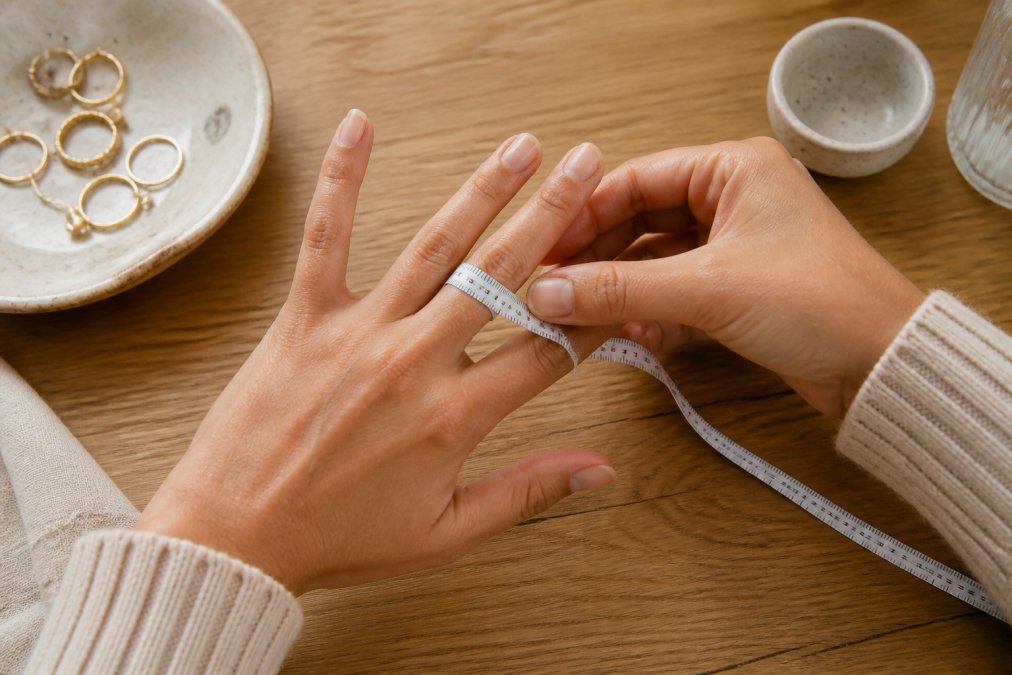
The string method is the most widely used approach for measuring ring size at home because it requires no specialist tools and gives a reliable circumference measurement that maps directly onto standard ring size charts.
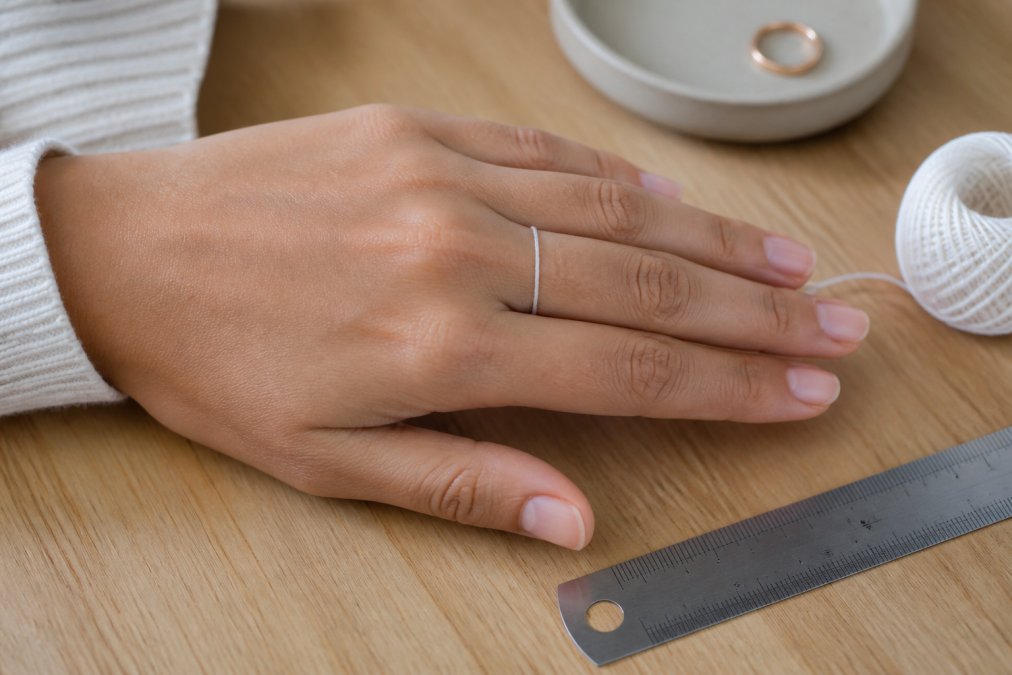
Step 1: Wrap the string around your finger
Cut a piece of non-stretchy string or paper strip approximately 10 cm long. Wrap it snugly around the base of the finger you intend to wear the ring on. The fit should feel like a comfortable ring: not loose enough to slide freely, not tight enough to dig in. If your knuckle is noticeably wider than the base of your finger, wrap the string around the knuckle instead and note both measurements.
Step 2: Mark and measure the length
Hold the string in place where the two ends meet and mark the exact point of overlap with your pen. Lay the string flat against your ruler and measure the distance from the end to your mark in millimetres. This measurement is your finger's circumference.
For example, a circumference of 52 mm corresponds to UK ring size L, while 57 mm corresponds to approximately UK size P.
Step 3: Convert the measurement to a ring size
Once you have your circumference in millimetres, use a UK ring size chart to find your size. Most charts list both the circumference and internal diameter alongside the corresponding letter size. The internal diameter is calculated by dividing the circumference by π (roughly 3.14159).
You can then check our size chart which simplifies things to Small, Medium, Large, XL and for some rings XXL.
According to the British Standards Institution's guidance on jewellery sizing, UK ring sizes are expressed as letters with half sizes available for a more precise fit. If your circumference sits between two standard sizes, always round up rather than down for comfort.
Measuring an Existing Ring for Size
The simplest way to measure ring size is to use a ring that already fits well. This approach is particularly useful when buying a surprise gift and you can borrow a ring the recipient already wears.
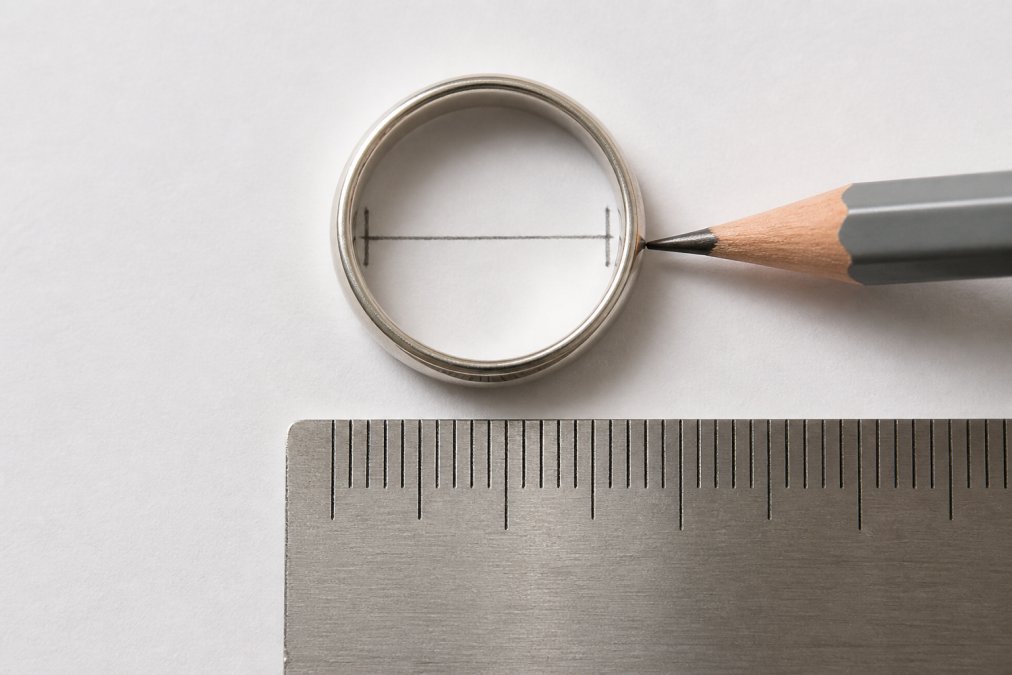
Place the ring flat on white paper and trace the inner circle with a pencil. Measure the diameter of that circle across its widest point using your ruler. This gives you the internal diameter in millimetres, which you can convert to a UK letter size using a standard chart.
A quick reference: an internal diameter of 15.9 mm corresponds to UK size H, while 18.2 mm corresponds to approximately UK size P. Measure the inside of the ring rather than the outside, as the internal diameter is what needs to match your finger.
UK Ring Size Chart: Circumference, Diameter, and Conversions
A UK ring size chart is the essential reference point once you have your measurement. The table below covers the most common UK sizes alongside their corresponding circumference and internal diameter in millimetres.
UK Size |
Circumference (mm) |
Internal Diameter (mm) |
|---|---|---|
H |
49.3 |
15.7 |
J |
51.5 |
16.4 |
L |
52.8 |
16.8 |
N |
55.1 |
17.5 |
P |
57.3 |
18.2 |
R |
59.5 |
18.9 |
T |
61.6 |
19.6 |
V |
63.8 |
20.3 |
For a printable ring size chart with the full range from size A to Z, the Assay Office's consumer jewellery guidance provides authoritative sizing references aligned with UK jewellery standards.
International ring size conversions
If you are buying from an international brand, the conversion table below will help. UK letter sizes do not correspond directly to US numerical sizes or European sizes, which are based purely on circumference in millimetres.
UK Size |
US Size |
EU Size |
Internal Diameter (mm) |
|---|---|---|---|
H |
3.75 |
46.5 |
15.7 |
L |
5.75 |
51.5 |
16.8 |
N |
6.75 |
54 |
17.5 |
P |
7.75 |
56 |
18.2 |
R |
8.75 |
58 |
18.9 |
T |
9.75 |
60 |
19.6 |
The European system is arguably the most logical because the size number equals the circumference in millimetres. When in doubt, always confirm the internal diameter in millimetres with the retailer, as that measurement is universal.
Average Ring Size for Women in the UK and What Affects It
The average ring size for women in the UK is Ncorresponding to an internal diameter of roughly 16.8 mm to 17.5 mm - and our size Medium. This is a useful starting point when buying a gift without direct measurement, though finger size varies considerably between individuals.
Several factors influence finger size:
- Temperature: Fingers contract in cold weather and expand in heat.
- Time of day: Fingers are generally slightly larger in the evening than in the morning.
- Exercise: Physical activity causes temporary swelling, particularly in the hands.
- Hormonal changes: Pregnancy, menstrual cycles, and certain medications can cause fluctuations in finger size.
- Age: Fingers tend to widen gradually over time.
Knuckle size vs. base size: which one to measure
For many people, the knuckle is noticeably wider than the base of the finger. If you size purely for the base, the ring may not pass over the knuckle. If you size for the knuckle, the ring may spin loosely once it is on.
Measure both the circumference at the base of your finger and at the widest point of your knuckle. If the difference is less than one full ring size, choose the larger size and accept a slightly looser fit at the base. If the difference is two or more sizes, consider comfort-fit or hinged ring designs that accommodate wider knuckles.
As documented in guidance from the Gemmological Association of Great Britain, comfort-fit ring shanks have a slightly rounded interior profile that makes them easier to slide over the knuckle while sitting snugly at the base.
How ring band width changes the fit
A narrow band and a wide band of the same nominal size do not fit the same way. Wide bands sit higher on the finger and exert more pressure across a larger surface area, making them feel tighter than a thin band of identical internal diameter. If you are ordering a band that is 6 mm or wider, go up half a size from your standard measurement. For bands 8 mm or wider, consider going up a full size.
Tips to Measure Ring Size at Home Accurately
Most sizing errors come from measuring at the wrong time of day, using stretchy material, or measuring the wrong finger.
Measure multiple times. Take the measurement at least three times and use the average. Small variations in how tightly you wrap the string can shift your result by a millimetre or more.
Use a paper strip rather than string where possible. A strip cut from standard A4 paper holds its shape, does not stretch, and marks cleanly.
Warm your hands first. Cold hands give a smaller reading than your actual resting size. Wash your hands in warm water before measuring.
Check the calibration of your printable template. If using a printable ring size chart, print at 100% scale (not "fit to page") and check the calibration box before using it.
Repeat on both hands. Measure the specific finger on the specific hand you plan to wear the ring on.
Common Mistake |
Why It Happens |
The Fix |
|---|---|---|
Measuring in the morning |
Fingers are smallest then |
Measure in the evening |
Using stretchy string |
Compresses under tension |
Use paper strip or non-stretch thread |
Ignoring knuckle size |
Most guides skip this |
Measure both base and knuckle |
Wrong print scale |
Default printer settings |
Print at 100%, check calibration mark |
Measuring wrong hand |
Assuming hands are equal |
Measure the hand you will wear the ring on |
What to do if you fall between two sizes
Falling between sizes is common. Here is a simple decision framework:
- For a thin band (under 4 mm): Choose the smaller size. Thin bands sit loosely and are comfortable even at a snug fit.
- For a wide band (6 mm or more): Choose the larger size. Wide bands feel tighter, so the extra room is welcome.
- If your knuckle is noticeably larger than your finger base: Choose the larger size and accept a slightly looser fit at the base.
- For a ring you plan to wear daily: Err on the side of slightly larger. Fingers swell with activity and heat.
- For a gift where you are unsure: Check the retailer's policy before ordering.
According to the Trading Standards guidance on distance selling and returns, consumers purchasing jewellery online have the right to return unworn items within 14 days under the Consumer Contracts Regulations.
Frequently Asked Questions
What is the most accurate way to measure ring size at home?
The most accurate method is to use a flexible measuring tape or a strip of paper wrapped snugly around the base of your finger, then measure the length in millimetres and match it to a circumference-based UK ring size chart. For the best result, measure at the end of the day when fingers are slightly warmer, take three separate readings, and use the largest measurement. If your knuckle is wider than the base of your finger, size up to ensure the ring passes over comfortably.
Can I use a piece of string to measure my ring size?
Yes. Wrap a thin piece of string or a narrow strip of paper around the base of your finger, mark where it overlaps, then lay it flat against a millimetre ruler. That length is your finger's circumference. Match the figure to a UK ring size chart to find your size. Avoid stretchy string, as it compresses against the finger and gives a reading that is too small. A strip of paper cut to roughly 1 cm wide is a more reliable alternative.
Does ring size change throughout the day?
Fingers do change size during the day due to temperature fluctuations, hydration levels, and physical activity. Fingers tend to be at their smallest first thing in the morning when the body is cool, and slightly larger in the evening after activity or warmth. For the most reliable measurement, measure ring size in the evening or after light activity, and avoid measuring when your hands are very cold or you have just finished exercise, as both extremes will skew the result.
How do I convert international ring sizes to UK sizes?
UK ring sizes use an alphabetical scale starting at A. European sizes use circumference in millimetres, US sizes use a numerical scale, and Japanese sizes use a different numerical system. A size L in the UK corresponds to roughly a US size 5.75 and a European size 50. The most reliable way to convert is to find the internal diameter or circumference of the ring in millimetres, then match that measurement directly to a UK ring size chart rather than converting between letter and number systems.
This article was written using GrandRanker
%0AStep%201:%20Wrap%20the%20string%20around%20your%20finger%0AStep%202:%20Mark%20and%20measure%20the%20...)