Best Way to Measure Finger Size for an Engagement Ring
Table of Contents
- Why Getting the Measurement Right Matters
- How to Measure Finger Size at Home: Four Methods That Work
- The Average Ring Size for Women (and Why It's Only a Starting Point)
- How to Use a Printable Ring Size Chart Correctly
- How to Measure Finger Size Without Them Knowing
- Knuckle vs. Base: Why One Measurement Isn't Enough
- How to Resize an Engagement Ring (and When You Can't)
- What to Do Once You Have the Number
- Frequently Asked Questions
Last Updated: September 13, 2026
Why Getting the Measurement Right Matters
The best way to measure finger size for an engagement ring comes down to one principle: measure the base of the finger, in millimetres, more than once. A ring that's too tight is uncomfortable; one that's too loose can slip off.
This guide from SilverStory covers the methods that work, the mistakes that ruin measurements, and how to measure finger size without the other person knowing.
How to Measure Finger Size at Home: Four Methods That Work
You don't need a jeweller's bench to measure finger size accurately. Four approaches cover almost every situation: the string method, the paper strip method, an existing ring, and a ring sizer or sizing kit.
The table below shows when each method makes sense.
| Method | Accuracy | Best For | Watch Out For |
|---|---|---|---|
| String or paper strip | Moderate | Quick at-home checks | Stretching the strip too tight |
| Existing ring | High | Measuring secretly | Only works if the ring fits that finger |
| Ring sizer / sizing kit | High | Gifting and proposals | Sizing kits vary between suppliers |
| Printable chart | Moderate | Cross-checking a number | Printing at the wrong scale |
The String or Paper Strip Method
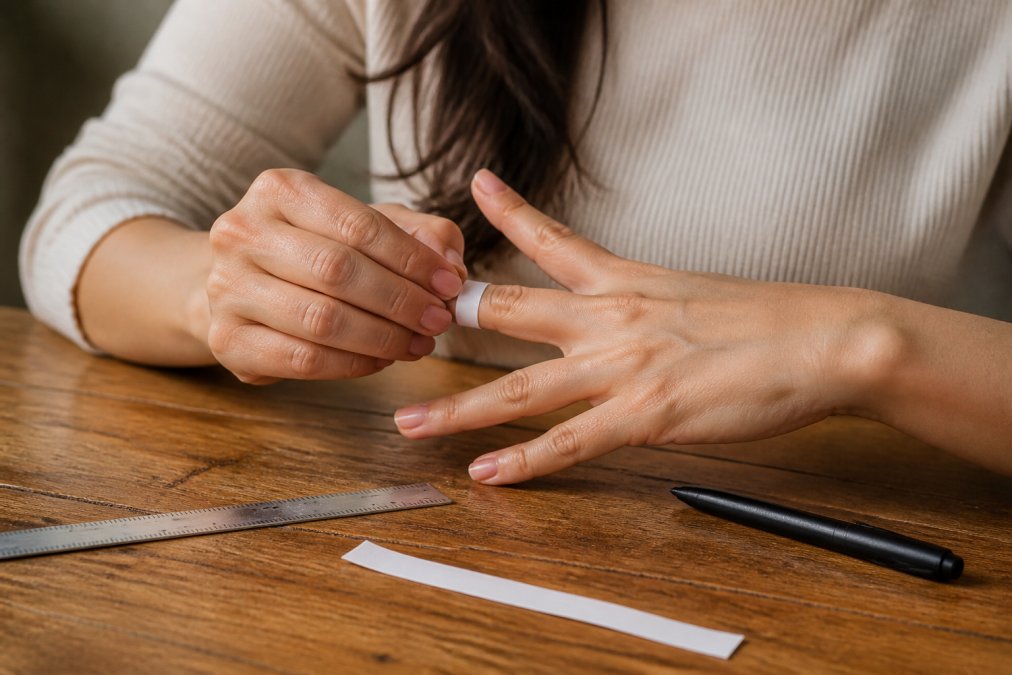
Wrap a strip of paper or non-stretchy string around the base of the finger, mark where the ends meet, then lay it flat against a ruler and record the length in millimetres. That's your circumference; divide by 3.14 for the diameter most charts use.
A few practical notes:
- Wrap snugly, not tightly. The strip should sit against the skin without pressing into it.
- Measure at the base of the finger, not across the knuckle.
- Take three measurements at different times of day and use the largest.
- If the strip stretches, your number will read too small.
Using an Existing Ring You Already Own
This is the most accurate home method, provided the ring fits the correct finger. Place it on a flat surface, measure the inside diameter in millimetres across the widest point, then compare against a conversion chart.
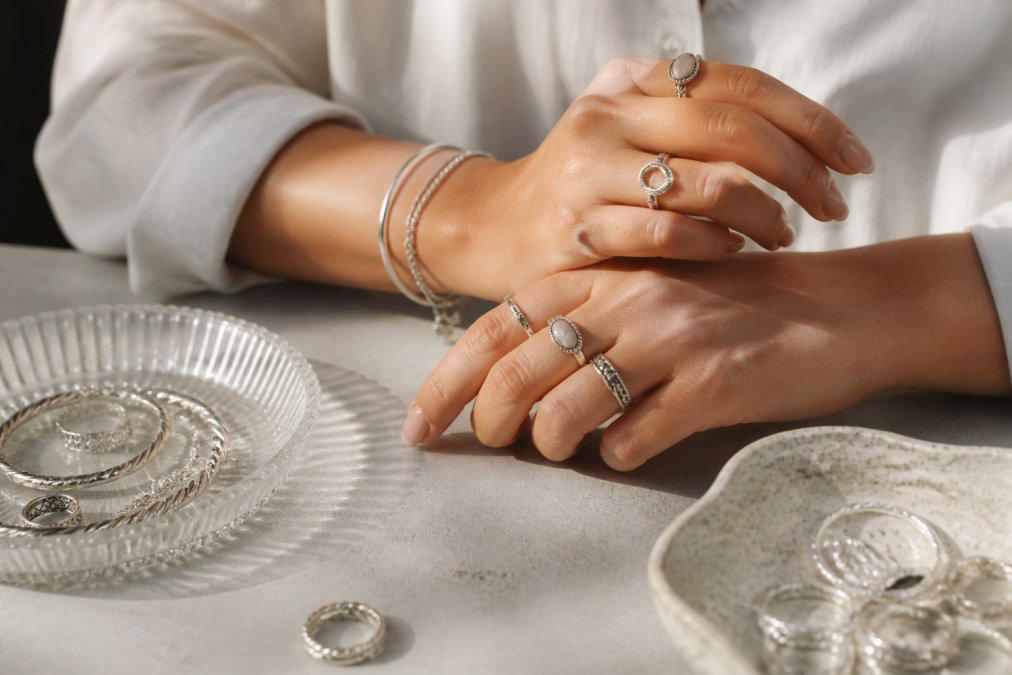
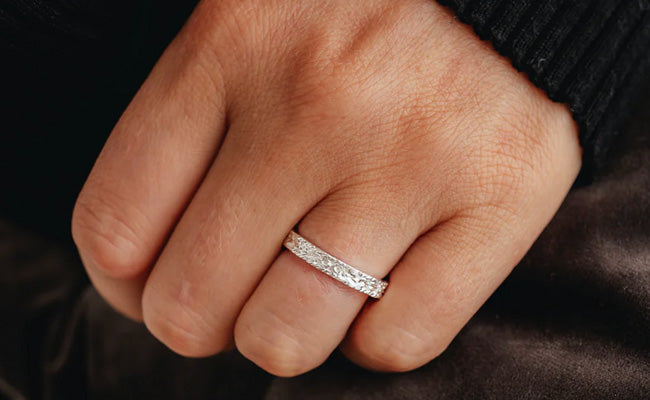
What most guides miss is that band width changes the fit. A wide band feels tighter than a narrow one at the same diameter, so if the existing ring has a slim shank and the new one is broader, size up (gem-a.com). SilverStory's Wide Hammered Band Ring has a band width of roughly 10mm, while the Silver Intricate Narrow Band Ring measures about 3mm. That difference matters more than most people expect.


A Ring Sizer or Sizing Kit
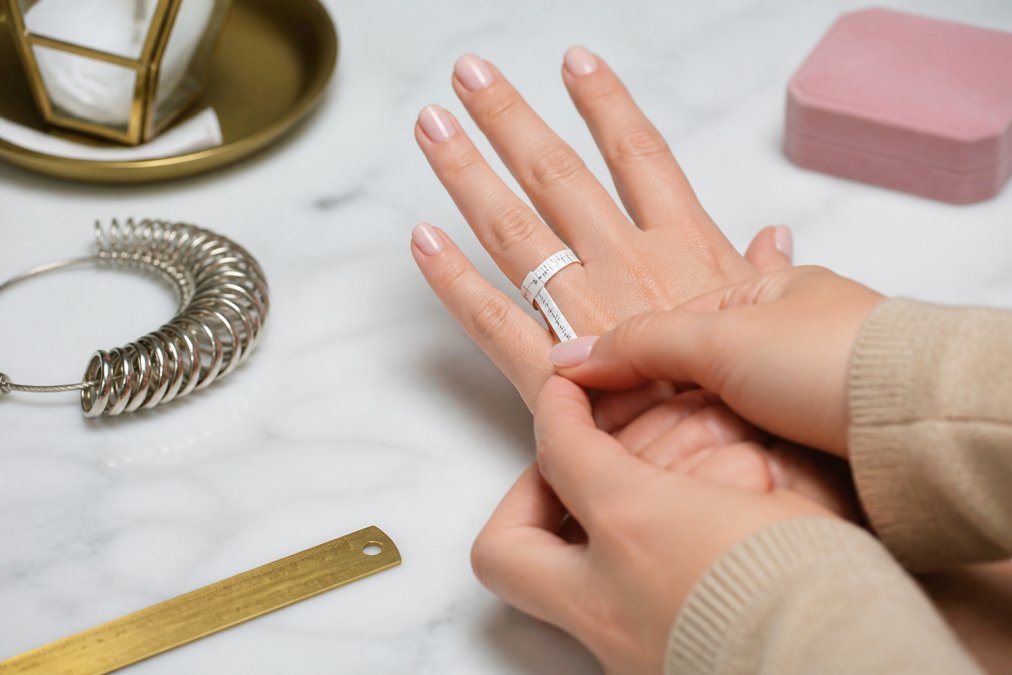
A ring sizer is a set of graduated metal or plastic rings, or an adjustable belt-style gauge. Slide candidates on until one passes over the knuckle with slight resistance and sits comfortably at the base.
Sizing kits sold online vary in calibration, so treat the number as a guide. A jeweller's mandrel gives a more reliable reading, so if the ring matters, have the final size confirmed in person.
The Average Ring Size for Women (and Why It's Only a Starting Point)
The average ring size for women is often quoted as a mid-range figure, but it says little about the individual finger you're measuring. Averages help jewellers plan stock, not size a ring worn daily.
Three factors push a real measurement away from any average:
- Finger shape. Tapered fingers and straight fingers of the same circumference take different sizes.
- Knuckle size. If the knuckle is wider than the base, the ring must clear it.
- Temperature and time of day. Fingers swell in heat and after exercise, and shrink in cold.
Use the average only as a sanity check: if your measurement lands far outside it, re-measure before assuming an error.
How to Use a Printable Ring Size Chart Correctly
A printable ring size chart works only if it prints at true scale. Most include a calibration line marked in millimetres or centimetres, which you must verify with a ruler before trusting anything else.
Once calibrated:
- Print at 100% scale, with no "fit to page" setting enabled.
- Check the calibration line against a physical ruler.
- Place an existing ring over the circles until you find the match.
- Read the size from the matching circle, then cross-check against your string measurement.
If the calibration line is wrong, every size on the sheet is wrong. This is the single most common reason printable charts fail.
How to Measure Finger Size Without Them Knowing
Measuring secretly is possible, and the existing-ring method is safest. Borrow a ring they wear on the intended finger, ideally while they sleep or shower, and measure its inside diameter or press it into soap to leave a measurable impression.
A few cautions:
- Confirm the ring is worn on the correct finger. A ring worn on the index finger tells you nothing about the ring finger.
- Note which hand. Dominant hands are often slightly larger.
- Return the ring exactly where you found it.
If you can't access a ring, ask a friend or family member to help, a second pair of hands is faster and less likely to be noticed.
Knuckle vs. Base: Why One Measurement Isn't Enough
A ring must pass over the knuckle, then sit securely at the base. Those points are rarely the same size, and one measurement can only satisfy one, the most common reason a ring that measured 'correctly' won't go on, or spins once it does.
Measure both points
Take two circumference measurements, not one:
- The base. Wrap your paper strip or string around the finger where the ring will sit, just below the knuckle. This is the size the ring should be once it's on.
- The knuckle. Wrap the same strip around the widest part of the knuckle, over the joint. This is the size the ring must be to get on.
Record both in millimetres. If the knuckle measurement is larger than the base, the knuckle is your limiting factor.
What the difference tells you
- Knuckle and base within about 1mm. A standard size works. Size to the base and the ring will clear the knuckle comfortably.
- Knuckle larger by 1-2mm. Size to the knuckle, then plan to manage the looseness at the base. A comfort-fit band, one that curves inward on the inside edge, often bridges this gap, because it feels tighter than its diameter suggests while still passing over the joint.
- Knuckle larger by more than 2mm. Sizing to the knuckle will leave the ring loose enough to spin and possibly slip off. The practical answer is a slightly larger size with sizing beads or a spring insert added by a jeweller, which hold the ring at the base while still clearing the knuckle.
Why comfort fit helps with large knuckles
A comfort-fit band is rounded inside rather than flat, so only a narrow strip of metal touches the finger. That reduces friction over the knuckle while the curve still grips at the base, the most useful design choice when the knuckle is wider than the base.
The arthritic or swollen knuckle
If the knuckle is enlarged through age, injury or arthritis, a hinged or open-shank design, or a ring with an adjustable insert, is more comfortable than forcing a fixed size over the joint (versusarthritis.org). Discuss options with a jeweller rather than guessing.
A note on which hand and which finger
The ring finger knuckle on the dominant hand is often slightly larger. If measuring secretly, confirm which hand and finger the ring is worn on before recording anything, a measurement from the wrong finger is worse than none.
How to Resize an Engagement Ring (and When You Can't)
Whether an engagement ring can be resized depends on the metal, band design and stone setting, and some modern metals can't be resized at all. Knowing this before you buy separates a ring that can be adjusted for life from one that must be replaced.
Metals that can be resized
- Sterling silver. Soft and workable, so a jeweller can usually add or remove metal to change the size. The trade-off is that silver scratches and deforms more easily, so it benefits from being handled by someone experienced.
- Yellow, white and rose gold. The most forgiving option. Gold can be cut, stretched or have a section added, and the join is then soldered and polished. Repeated resizing thins the band over time, so it's a correction rather than a routine.
- Platinum. Resizable, but it demands a higher working temperature and more skill than gold. A good bench can do it; a general repair shop may not.
Metals that cannot be resized
- Tungsten carbide. Extremely hard and brittle. It cannot be cut and re-joined, so a tungsten ring is effectively a fixed size. If the finger changes, the ring is replaced, not adjusted.
- Titanium. Light and strong, but it cannot be soldered or stretched in the way gold can. Some specialists can resize certain titanium bands, but it is not a routine job and many jewellers will refuse.
- Stainless steel. Similar problem: hard to solder cleanly, so resizing is unreliable and often not offered.
- Damascus steel and ceramic. Treated as non-resizable in practice.
If the ring is for a finger that may change, through pregnancy, weight change or age, the resizable metal is the safer long-term buy.
Design limits, even in resizable metals
Metal is only half the story. The band design sets its own ceiling:
- Plain bands in silver, gold or platinum are the easiest to resize, often by one or two sizes in either direction.
- Full eternity rings, where stones run all the way around the band, are the hardest. Resizing disturbs the settings and risks loosening stones, so many jewellers will only resize down, and only slightly.
- Channel-set and pavé bands carry similar risk, the metal around the stones is thin, and altering it can shift the setting.
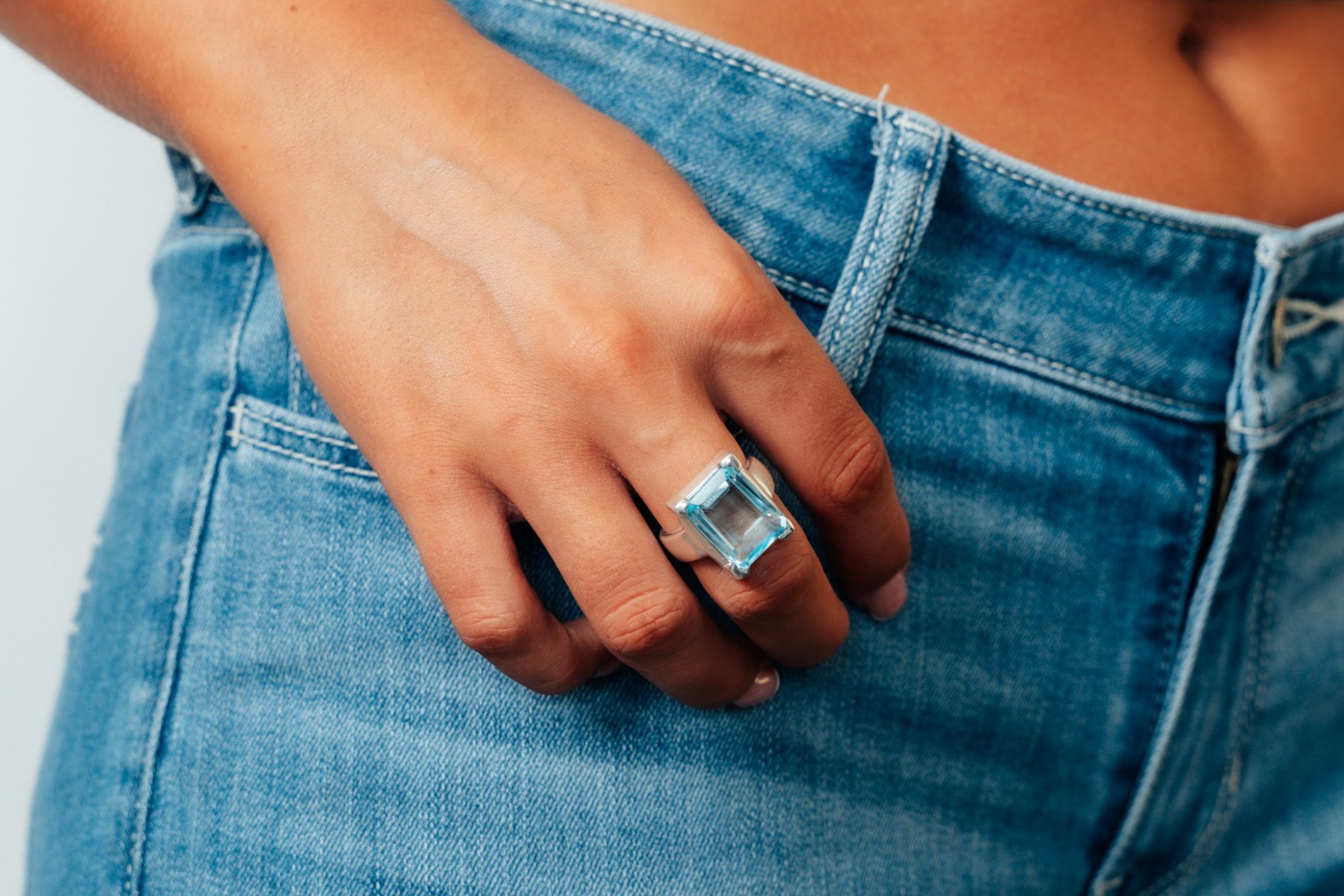
- Cluster and multi-stone designs, such as a cluster gemstone ring, need more care on the bench than a plain band because the setting must stay true while the shank is worked.
- Engraved or patterned bands can lose their finish at the join, which may need re-cutting.
How much can a ring be resized?
As a rule, most jewellers will adjust a plain band by up to about two sizes either way. Beyond that, proportions change, metal thins and the ring can lose its shape. Going down more than two sizes is harder than going up, since metal must be removed rather than added.
The practical rule
Buy as close to the correct size as you can, and treat resizing as a correction rather than a plan. Repeated resizing weakens metal and shortens the life of settings on eternity or channel-set bands. If unsure, choose a plain or lightly set band in silver, gold or platinum rather than a metal or style that locks you in.
What to Do Once You Have the Number
Take your measurement to a jeweller for confirmation before ordering, especially for a piece worn daily. If you're choosing yourself, our Tiny Heart Ring starts at size XXS, suiting smaller fingers many ranges skip.
Getting the size wrong is the most common reason an engagement ring goes back to the bench, and it's avoidable with a paper strip, an existing ring, and a second measurement at a different time of day. At SilverStory, every ring is handcrafted by skilled artisans in Rajasthan from ethically sourced sterling silver, made to be worn and treasured rather than replaced. Our rings come in many sizes at affordable pricing. Get started with SilverStory and find a ring that fits the finger and the moment.
Frequently Asked Questions
How do I figure out my engagement ring size?
Wrap a piece of string or a paper strip around the base of your finger, mark where the ends meet, then measure that length in millimetres against a ring size chart. Measure at the end of the day when your fingers are largest, and check the knuckle too, because a ring must pass over it. If the two measurements differ, size to the larger one and choose a comfort fit band.
Is it better to size up or down for rings?
Size up rather than down. Fingers swell with heat, exercise and time of day, and a ring that is slightly loose can still be worn safely, while one that is too tight can cut off circulation and become uncomfortable within hours. A wide band also needs extra room, so if you are choosing between two sizes on a 10mm band, take the larger.
Can my phone measure my ring size?
Some apps claim to measure ring size using your phone screen or camera, but accuracy depends on calibration and screen resolution, so results vary. Treat any app reading as a rough estimate only. A printable ring size chart or a physical ring sizer gives a more reliable measurement, and it costs very little to order one before you commit to a ring.
How can I measure ring size without them knowing?
Borrow a ring they already wear on the correct finger and press it onto a printable ring size chart, or trace the inside of the band on paper and measure the diameter in millimetres. If you cannot access a ring, ask a friend or family member for their size, or check whether they have mentioned a size when browsing jewellery online. Never guess from glove size alone.