
How to Identify Real Kundan Jewellery: 2026 Guide
Table of Contents
- What You Need Before You Assess a Piece
- What Real Kundan Jewellery Is and How It Is Made
- Step-by-Step: How to Identify Real Kundan Jewellery
- The Difference Between Polki and Kundan
- Kundan vs Imitation: Telling Authentic from Glass Stones
- How to Clean Kundan Jewellery at Home
- Common Mistakes When Buying Kundan Jewellery
- Conclusion
- Frequently Asked Questions
Last Updated: September 21, 2026
What You Need Before You Assess a Piece
You can learn how to identify real Kundan jewellery with three tools: a magnifying loupe, a small magnet, and good daylight. Real Kundan jewellery is a traditional Indian craft in which uncut stones sit in a hand-built gold foil setting on a metal frame.
This guide from SilverStory walks you through each check, step by step.
SilverStory works with artisans in Rajasthan, where Kundan work has passed between families for generations, heritage that shows up in the small details you will learn to spot.
Before you start, gather these:
- A jeweller's loupe (10x magnification)
- A small magnet
- A soft cloth
- Strong daylight or a bright lamp
- A kitchen scale, if you want to compare weight
Most guides stop at "look for a smooth finish." Below, we show you what to actually look for, and where fakes give themselves away.
What Real Kundan Jewellery Is and How It Is Made
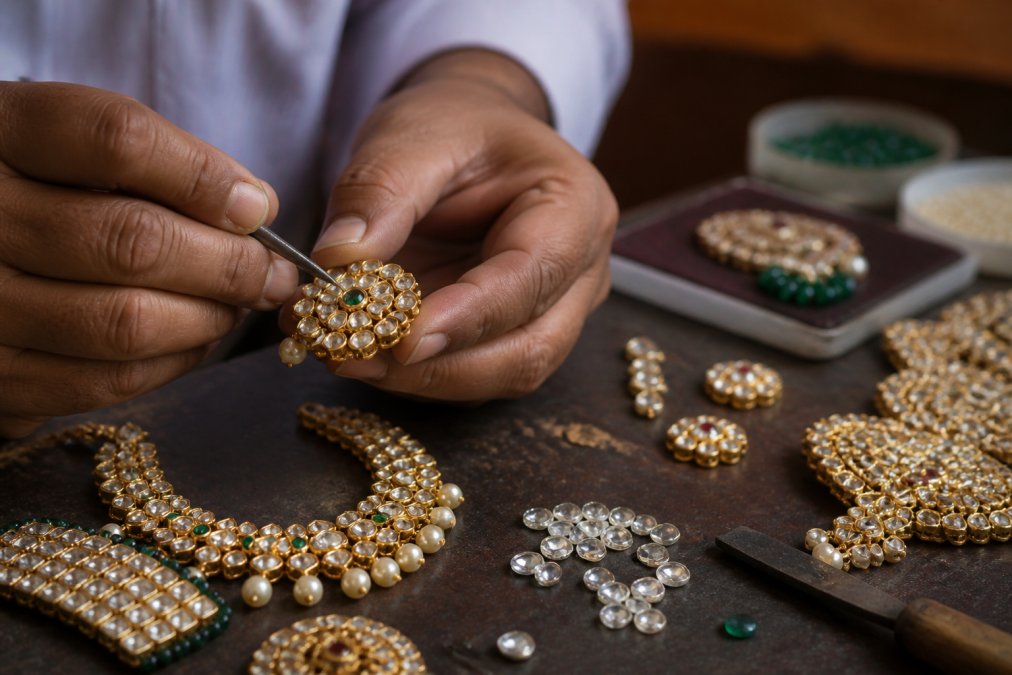
Kundan jewellery is a form of traditional Indian jewellery in which carefully cut pieces of gold foil are pressed around uncut stones and set into a metal frame, usually finished with enamel work on the reverse. The technique is known as kundan setting, and it is closely related to jadau work.
The process is slow and entirely handcrafted: an artisan shapes a metal frame, then presses layer after layer of gold foil around each stone until it holds firm. No glue, no prongs, just metal, foil, and pressure.
That construction is your first test. Glue and prongs belong to imitation pieces. Real Kundan holds stones through the foil itself.
The role of gold foil and the kundan setting
Gold foil is the heart of the craft: pure gold is soft enough to press around a stone without cracking it, gripping it and locking it into the frame.
On a genuine piece, the foil sits flush against the stone, smooth and continuous rather than lumpy or patchy. Visible glue is a clear sign of an imitation.
Meenakari work on the reverse side
Flip the piece over. Genuine Kundan jewellery often carries meenakari, a form of enamel work, on the back.
Meenakari is fired enamel in bright colours, and it takes real skill to apply. On an authentic piece, colours sit inside clean outlines without bleeding, and the finish looks even, with no bare patches.
Imitation pieces rarely bother with the reverse side at all, so a plain metal back with no detailing is a warning sign.
Step-by-Step: How to Identify Real Kundan Jewellery
Work through the process in order, giving each step a minute or two. The first four steps are visual and can be done anywhere; the last two require paperwork or a professional, and they settle the question.
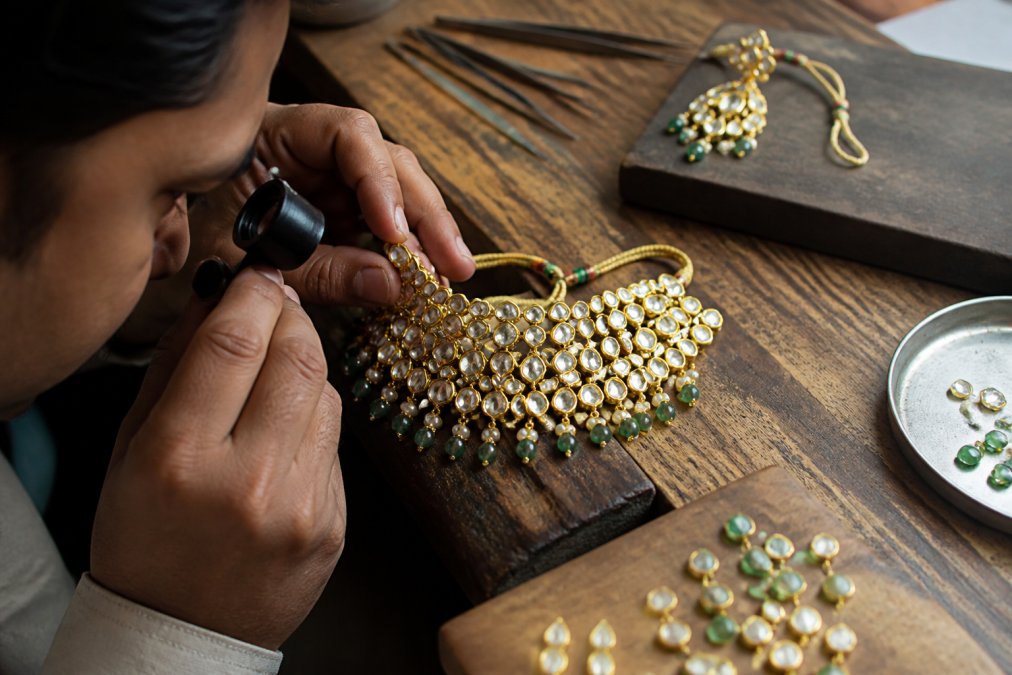
Step 1: Check the stones. Real Kundan uses uncut diamonds or polki, which have a raw, uneven surface with natural inclusions and irregular colour. Glass stones look too smooth and uniform. Slight irregularities are a sign of the real thing.
Step 2: Inspect the gold foil. The foil should sit tight and smooth against each stone, pressed in layers rather than glued; loose, wrinkled, or patchy foil points to a fake. Under a 10x loupe, it should wrap the girdle of the stone, not sit behind it.
Step 3: Look at the reverse side. Check for meenakari enamel: clean outlines and even colour are good signs, a bare, plain back is not.
Step 4: Test the metal. A small magnet will not stick to gold or silver; if it grabs the piece, the metal is likely coated base metal.
Weight, finish and stone clarity checks
Weight is one of the easiest checks: a real Kundan necklace or pair of earrings feels solid, not like painted plastic.
When to seek a professional appraisal or lab report
Visual checks catch most fakes but cannot confirm stone identity or gold fineness. For any piece sold as polki or as containing uncut diamonds, an independent appraisal is the only way to be sure.
The Difference Between Polki and Kundan
The difference between Polki and Kundan comes down to the stone, not the setting. Polki uses raw, uncut diamonds in their natural state. Kundan jewellery can use a wider range of stones, including uncut diamonds, glass, or gemstones, all held in the same gold foil setting.
Kundan vs Imitation: Telling Authentic from Glass Stones
The fastest way to tell authentic Kundan from an imitation is to look at the setting and the back. Real Kundan holds stones with hand-pressed gold foil and often carries meenakari on the reverse. Imitation pieces use glue, prongs, or a plain metal back.
Here is a quick summary table:
| Feature | Authentic Kundan | Imitation |
|---|---|---|
| Stone setting | Gold foil, hand-pressed | Glue or prongs |
| Stones | Uncut, uneven surface | Glass, too uniform |
| Reverse side | Meenakari enamel | Plain metal |
| Weight | Solid, has heft | Light, hollow |
| Finish | Hand-polished, slight variation | Machine-perfect or rough |
| Hallmark | Present on precious metal | Often missing |
How to Clean Kundan Jewellery at Home
You can clean Kundan jewellery at home with a soft cloth and plain warm water, but keep harsh cleaners away, the gold foil and enamel are delicate, and strong chemicals can dull or damage them.
Follow these steps:
- Wipe the piece with a dry, soft cloth after each wear to remove skin oils and perfume residue
- Dip a soft cloth in lukewarm water and gently wipe the surface, no soaking
- Never scrub, and never use a brush with stiff bristles
- Avoid perfume, hairspray, sunscreen, and household cleaning sprays
- Dry fully with a lint-free cloth before storing
- Store each piece in its own soft pouch or a lined compartment
Storage, humidity and long-term care
Maintenance matters more than most buyers expect: a piece wiped and stored well keeps its shine for years, while one left in a damp box or worn in the shower will not.
What to do if the foil lifts or enamel chips
If a stone feels loose or the foil has lifted, stop wearing the piece and do not press the stone back yourself, foil is set with controlled pressure by a trained kundan saaz, and home repairs usually make it worse. Take it to a jeweller who works with kundan or jadau settings; a single stone can often be re-set without disturbing the rest, if the surrounding foil is intact.
Store Kundan pieces in a dry place, away from direct sunlight. Humidity dulls the finish over time, and sunlight can fade the enamel on the reverse side.
Common Mistakes When Buying Kundan Jewellery
Other common errors:
- Assuming a smooth finish means it is real
- Buying without checking for a hallmark
- Trusting a seller who cannot explain the stone setting
- Skipping the weight check
- Paying for "gold" without confirming the gold purity
- Never asking about the source of the stones
If you want a piece with documented, ethical sourcing and genuine handcrafted work, that is exactly the standard SilverStory holds its pieces to.
Conclusion
Spotting real Kundan jewellery comes down to a handful of checks: the foil, the stones, the back, and the weight. Run them in order and you will catch most fakes in under a minute.
Frequently Asked Questions
How can you tell the difference between Polki and Kundan?
Polki uses uncut diamonds in their natural state, set in gold with no foil backing, so light passes through the stone. Kundan uses glass or semi-precious stones layered over gold foil, which gives the piece its signature glow. Both are forms of jadau jewellery. Check the reverse side: Polki settings are open, while Kundan foil is usually visible behind the stone.
Does real Kundan jewellery use gold or glass?
Authentic Kundan jewellery typically uses 22-carat gold for the frame and gold foil behind the stones. The stones themselves can be glass, semi-precious or uncut diamonds depending on the piece. Imitations use base metals with gold plating and acrylic or plastic stones instead. Look for a UK hallmark on the metal, which confirms the gold purity, and check that the foil behind each stone has a warm yellow tone rather than a dull grey or silver finish.
How do I care for my Kundan jewellery to maintain its value?
Keep Kundan pieces away from water, perfume and hairspray, as moisture can lift the gold foil and dull the meenakari enamel. Store each item in a soft cloth pouch or a lined box, separate from other jewellery to avoid scratches. Clean gently with a dry, soft brush only, never soak the piece. For deeper cleaning or repairs, take it to a qualified jeweller. Proper care preserves the appearance of handcrafted Kundan jewellery.
Is real Kundan expensive?
Authentic Kundan jewellery commands a higher price because of the handcrafted process, gold content and artisanal labour involved. Each piece is built up stone by stone, often with meenakari enamel on the reverse, which takes many hours of skilled work. The final cost depends on the gold purity, the number and quality of stones, and the complexity of the setting. Imitation pieces are much cheaper but do not hold value the same way.
The challenge with Kundan is that quality varies wildly, and the details that matter are easy to miss. SilverStory takes that guesswork out of the equation. Every piece is ethically sourced, handcrafted by artisans in Rajasthan, and priced to be accessible without cutting corners on the craft. Get started with SilverStory and add a piece you will actually treasure.