Common Mistakes When Measuring Ring Size
Table of Contents
- Why Getting Ring Size Wrong Costs You Money
- How to Measure Ring Size at Home: The Right Way
- Temperature, Time of Day, and Other Hidden Variables
- The Knuckle vs. Base Dilemma: Solving the Fit Problem
- How Should an Engagement Ring Fit
- Average Ring Size for Women and Sizing Standards
- Common Mistakes to Avoid When Measuring Ring Size
- When to Get Professional Help
- Frequently Asked Questions
Last Updated: September 29, 2026
Why Getting Ring Size Wrong Costs You Money
An ill-fitting ring means returns, reshaping costs, or worse, wearing something uncomfortable. An ill-fitting ring means returns, reshaping costs, or worse, wearing something uncomfortable.
Measuring ring size at home isn't complicated, but specific pitfalls trip people up: temperature changes, time of day, hand swelling, and band width all affect fit. Most guides gloss over these factors.
This guide covers the exact process to get it right the first time: what causes measurement errors, how to avoid them, and when professional help is worth the investment.
How to Measure Ring Size at Home: The Right Way
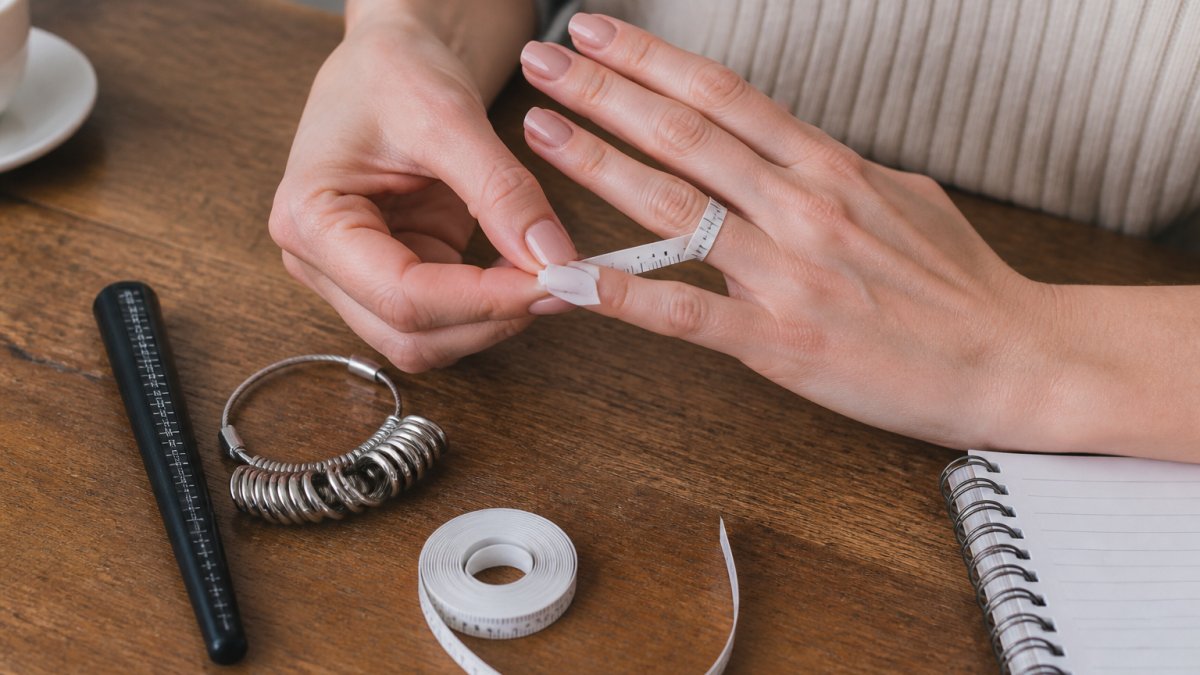
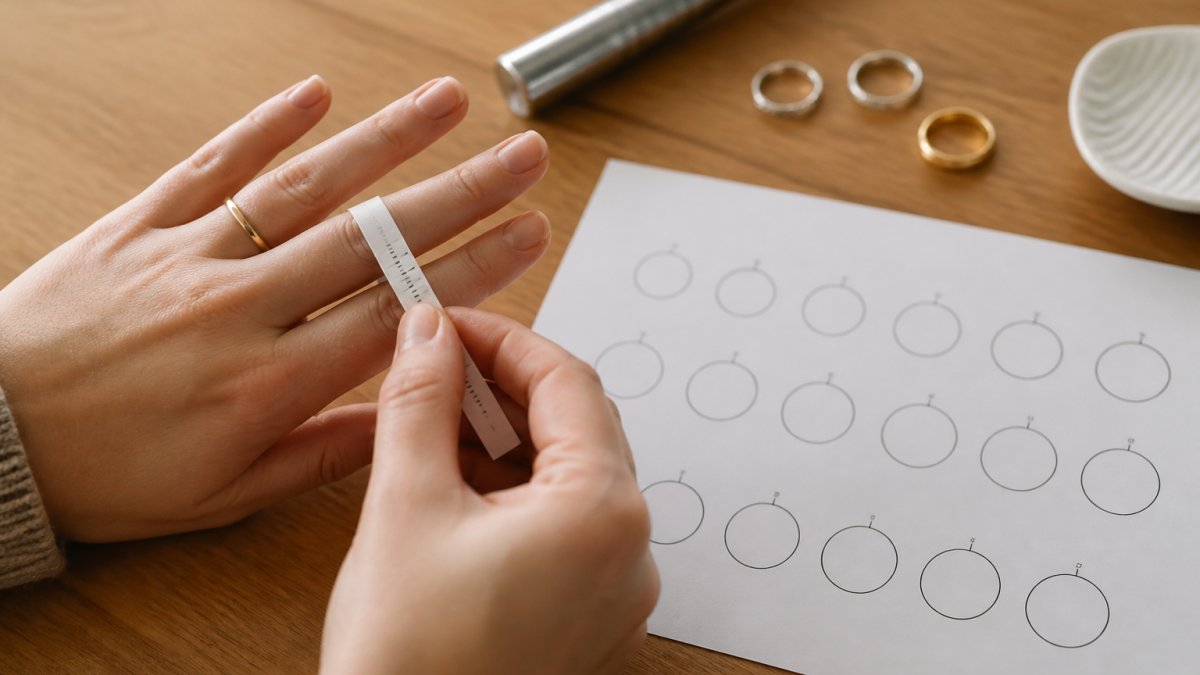
You can measure ring size accurately at home with tools you already have, no expensive equipment needed.
What You'll Need
Gather these items before you start:
- A piece of string or dental floss (not elastic)
- A ruler or measuring tape in millimetres
- A pen or marker
- A ring that fits well on the finger you're measuring
- Paper to write down your measurements
A ring mandrel is optional; string works equally well.
Step-by-Step Measurement Process
Step 1: Choose the Right Time
Measure in the afternoon or evening when fingers are larger due to fluid retention and circulation. Morning measurements are typically too small.
Step 2: Use an Existing Ring
Use a ring that fits comfortably, it should slide on with slight resistance and not spin freely.
Step 3: Wrap and Mark
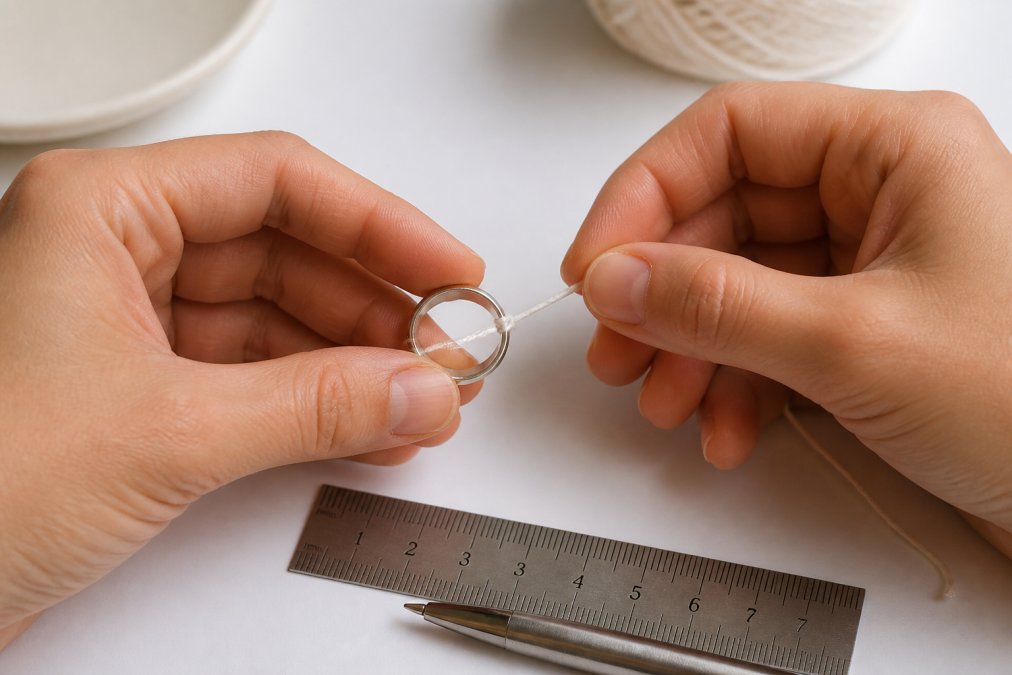
Wrap string around the inside of the ring, mark where it overlaps, and keep it snug but not compressed.
Step 4: Measure the String
Measure the string on a ruler in millimetres and record the number.
Step 5: Convert to Ring Size
Use a sizing chart to convert your measurement to UK ring size. Each millimetre is roughly one-quarter of a size.
Step 6: Measure Multiple Times
Take at least three measurements and use the largest number to account for natural hand swelling.
Temperature, Time of Day, and Other Hidden Variables
Ring size varies throughout the day, across seasons, and with lifestyle factors. Understanding these variables ensures your ring fits during actual daily life.
Temperature and Seasonal Changes
Temperature affects finger size through vascular response: cold makes fingers smaller, warmth increases volume. Winter-to-summer differences can be half a size.
If buying for year-round wear, measure during your most-worn season or size up half a size for seasonal swelling.
Time of Day: The Most Underestimated Factor
Time of day matters significantly: morning measurements can be 0.5-1 full size smaller than evening measurements.
Hands swell naturally throughout the day as circulation increases and fluid accumulates. Fingers are largest by late afternoon or early evening.
Always measure between 2pm and 6pm to ensure your ring fits during active wear hours.
Physical Activity and Exercise-Induced Swelling
Exercise causes temporary finger swelling of 0.5-1.5mm, enough to affect ring fit noticeably.
If you exercise regularly, measure after your usual routine to ensure your ring fits when fingers are naturally swollen.
If you exercise intensely or wear your ring during workouts, consider sizing up half a size to prevent circulation restriction.
Hydration, Salt Intake, and Fluid Retention
Hydration and salt intake directly affect finger size: dehydration makes fingers smaller, high salt intake causes swelling.
High-sodium meals or excess water cause swelling within 1-2 hours; dehydration makes fingers smaller.
Measure on a typical day with normal hydration and salt intake to ensure your ring fits during daily life.
Hormonal Changes and the Menstrual Cycle
Women often experience finger swelling during the luteal phase (days 15-28) due to hormonal changes increasing fluid retention.
If you experience significant monthly swelling, measure during your typical state or size up half a size for comfort throughout your cycle.
If unsure about swelling impact, measure across a full cycle. If measurements vary by more than 1mm, size up slightly.
Pregnancy and Fluid Retention
Pregnancy causes progressive finger swelling due to increased blood volume and fluid retention, particularly in the third trimester.
If buying while pregnant, measure at your current stage and consider sizing up half to one full size to accommodate continued swelling.
After pregnancy, finger size typically returns to pre-pregnancy measurements within weeks to months, so resizing may be needed.
Practical Strategy: The Three-Measurement Rule
Take at least three measurements across different days and conditions. If they vary by more than 1mm, use the largest measurement to ensure your ring won't be too tight.
The Knuckle vs. Base Dilemma: Solving the Fit Problem
A ring must fit both your knuckle and finger base. If your knuckle is significantly larger, standard sizing won't work.
Your knuckle is wider than your finger base. A ring sized for your base may not slide over your knuckle; one sized for your knuckle will be loose on your base.
Test by sliding an existing comfortable ring over your knuckle. If it gets stuck, you need a larger size, typically half to one full size up.
How Should an Engagement Ring Fit
An engagement ring should fit snugly but not tightly, slide on with slight resistance and sit still without spinning.
The ideal fit takes gentle effort to slide on and sits still without rotating or moving freely.
Too tight causes discomfort and restricts circulation; too loose risks loss. The sweet spot feels natural within minutes.
Comfort-fit bands have a curved interior that distributes pressure evenly and feel better during extended wear.
Average Ring Size for Women and Sizing Standards
The average UK women's ring size is between H-J, but hand size varies considerably based on height, build, and genetics.
Understanding UK Ring Sizing
UK ring sizes use letters (A-Z, then AA onwards), each representing a specific internal diameter. Half-sizes allow precise fitting.
The International Sizing Problem
One of the most common and costly mistakes occurs when buying rings online from international retailers without understanding how sizing systems differ. The US, UK, and EU each use entirely different sizing standards, and direct conversions are unreliable.
US sizing uses numbers (typically 3-13, with half-sizes).
EU sizing uses millimetre measurements directly (e.g., 54mm, 57mm), which can seem straightforward but often rounds differently than UK conversions.
UK sizing uses letters and is the most precise when you have a millimetre measurement, because each size corresponds to a specific diameter without ambiguity.
When purchasing from an international seller, always request the internal diameter in millimetres rather than relying on size conversions.
Band Width and Fit Adjustments
Band width affects how a ring should fit and how sizing standards apply. Standard-fit bands have a flat or slightly curved interior. Comfort-fit bands have a more pronounced curve that distributes pressure more evenly.
A narrow band (under 4mm) can be sized slightly tighter because it concentrates less pressure on any single point of the finger. A wider band (over 6mm) should be sized slightly looser, typically half a size up, to prevent discomfort during extended wear. Very wide bands (8mm or more) may require a full size increase to feel comfortable.
This is why band width must be considered alongside your base measurement. A ring that fits perfectly at size J in a 3mm band may feel uncomfortably tight in a 7mm band at the same size. When ordering, always specify both your measured size and the band width you're considering, so the jeweler can advise on any adjustment needed.
Resizing Limitations by Metal and Design
Not all rings can be resized easily, and this affects how critical accurate initial sizing becomes. Understanding these constraints helps you choose the right size from the start.
Precious metals (gold, platinum, silver) can typically be resized up or down by one full size without structural issues.
Common Mistakes to Avoid When Measuring Ring Size
Most mistakes happen before you even measure. Here's what to watch for.
When to Get Professional Help
Sometimes DIY measurement isn't enough. A jeweler can size you accurately in minutes and account for hand quirks that home measurement might miss.
Frequently Asked Questions
What's the most accurate way to measure ring size at home?
Use a ring mandrel or sizing chart with a ring that already fits comfortably on your finger. Wrap a soft tape measure around the widest part of your finger at room temperature. Record the measurement in millimetres and cross-reference it with a standard sizing chart. For the most reliable result, measure the same finger multiple times across different days to account for natural daily variation.
How does temperature and time of day affect measuring ring size?
Fingers swell throughout the day due to fluid retention, circulation, and activity levels. Warmer temperatures cause blood vessels to dilate, increasing swelling. Avoid measuring after exercise, hot showers, or in warm environments. If you measure in the evening or after physical activity, your measurement will be larger than your actual base ring size, leading to an ill-fitting ring.
Should I measure my engagement ring size differently than other rings?
Rings that sit permanently on your finger should fit snugly at the base with minimal movement. They need to accommodate slight swelling without becoming uncomfortable. Measure at a time when your finger is at its normal state, not swollen or particularly slim. A ring should slide over your knuckle with slight resistance but sit securely at the base. If you have a large knuckle relative to your finger base, you may need a comfort-fit band or consider sizing up half a size.
What is the average ring size for women, and how do sizing standards vary?
The average ring size for women in the UK is typically between size J and L (equivalent to US sizes 5-7). However, sizing standards can vary by region and jeweller. Always confirm which sizing system your jeweller uses, as some follow UK standards whilst others use US or European measurements. If you're ordering online, check the sizing chart provided by the retailer to ensure accuracy. When in doubt, measure your own finger rather than relying on averages, as individual variation is significant.
Getting your ring size right matters. A well-fitting ring becomes part of your daily life. At SilverStory, we want your handcrafted piece to feel perfect from day one. Use the measurement process we've outlined, account for the variables we've covered, and don't hesitate to reach out if you're unsure. Our team is happy to help you find your exact size, and we stand behind every piece we create. Add your perfect ring to your collection today.