How to Tell If Silver Is Real: 7 Simple Tests
Table of Contents
- What You'll Need Before Testing Real Silver
- Hallmarks on Silver Jewellery: What to Look For
- Sterling Silver vs Silver Plated: The Key Differences
- How to Tell If Silver Is Real: 5 At-Home Tests
- Silver Purity Testing Methods: Destructive vs Non-Destructive
- Common Mistakes When Checking Silver Authenticity
- Conclusion
Last Updated: August 18, 2026
Knowing how to tell if silver is real is more useful than most people realise. The resale market for silver jewellery and bullion has grown considerably, and with it, the number of silver-plated or base metal pieces sold as genuine sterling. At SilverStory, we work with sterling silver every day, and we know exactly how easy it is to be deceived. This guide covers seven practical tests, from quick at-home checks to professional methods, so you can buy and wear with complete confidence.
Testing a piece of jewellery for personal wear is a completely different challenge from authenticating investment-grade bullion. The approach that works for one can mislead you on the other. Below, we'll walk through both, starting with what to look for before you run a single test.
What You'll Need Before Testing Real Silver
Before reaching for a magnet or bleach, take stock of what you actually have. The right test depends on the form of silver: a piece of jewellery, a coin, a bar, or flatware each calls for a slightly different approach.
For basic at-home testing, gather:
- A strong neodymium magnet
- An ice cube
- A small piece of white cloth or tissue
- A drop of household bleach (used carefully)
- Good lighting and a magnifying glass
For more rigorous testing, you'll want an acid test kit designed for precious metals, or access to a professional jeweller with electronic testing equipment. Some tests are destructive and leave a mark, while others are entirely non-destructive. Choosing the wrong test for a valuable piece could damage it permanently.
Real silver tarnishes. A piece that has never darkened, even after months of wear, may be silver-plated over a base metal rather than solid sterling. That tarnish is actually a sign of authenticity.
| Test | Destructive? | Best For | Skill Level |
|---|---|---|---|
| Magnet test | No | Jewellery, coins, bars | Beginner |
| Ice cube test | No | Bars, larger pieces | Beginner |
| Ring/sound test | No | Coins, bars | Beginner |
| Tarnish/oxidation test | No | Jewellery, flatware | Beginner |
| Bleach test | Minor risk | Jewellery | Intermediate |
| Acid test kit | Yes (surface mark) | All silver types | Intermediate |
| Electronic/XRF testing | No | Investment bullion | Professional |
Hallmarks on Silver Jewellery: What to Look For
The single most reliable non-destructive method for checking silver jewellery is examining the hallmark. A hallmark is an official mark stamped onto precious metal to certify its purity and origin, and in the UK, hallmarking is mandatory.
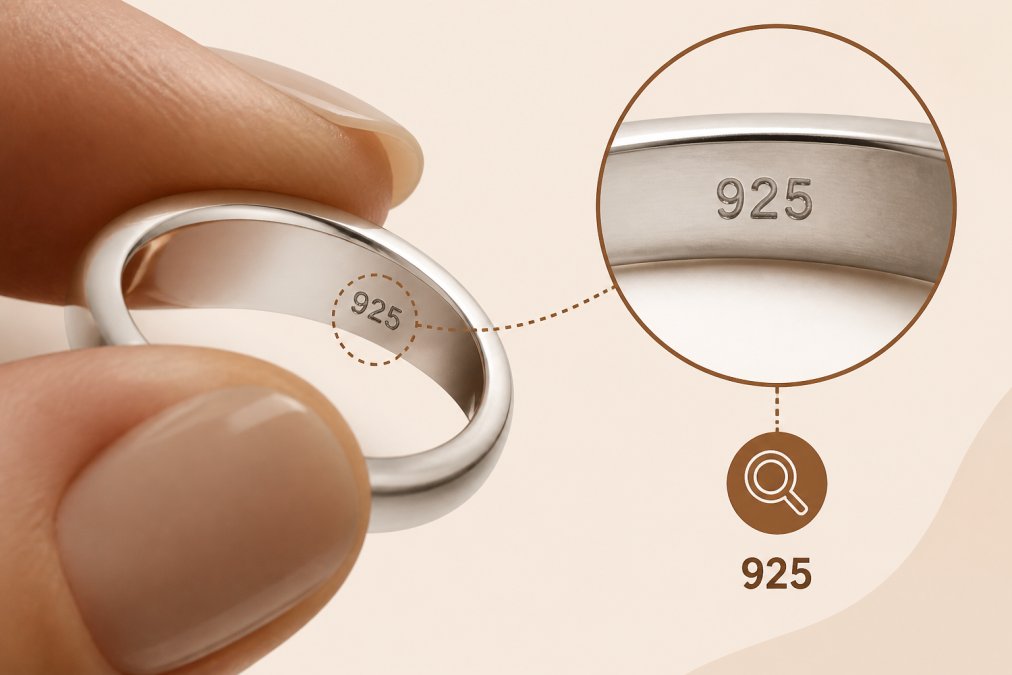
The 925 Stamp and Other Purity Marks
Sterling silver is defined as an alloy containing 92.5% pure silver, with the remaining 7.5% typically copper. The 925 stamp is the most widely recognised purity mark, found on the inner band of rings, the clasp of necklaces, and the back of earring posts.
Other purity marks you may encounter:
- 800, 80% silver, common in older Continental European pieces
- 830, 83% silver, often found on Scandinavian antiques
- 958, Britannia silver, 95.8% purity, rarer and softer
- 999, Fine silver, used in bullion bars and some coins
A piece stamped 925 is sterling silver. A piece stamped 925 GP is gold-plated sterling silver. A piece with no stamp could still be silver (older pieces predate mandatory hallmarking), but the absence of a mark should prompt further testing.
Assay Office Marks and UK Hallmarking Law
Under the UK Hallmarking Act 1973 as amended, all precious metal articles sold in the UK above a certain weight threshold must be hallmarked by one of the four recognised Assay Offices: London, Birmingham, Sheffield, or Edinburgh. Each office uses a distinct town mark alongside the purity mark and a sponsor's mark identifying the maker.
A full UK hallmark contains:
- The sponsor's mark (maker or retailer)
- The metal and purity mark (e.g., the lion passant for sterling silver)
- The Assay Office mark
- Optionally, a date letter
The British Hallmarking Council's guidance on hallmark recognition is the authoritative reference for decoding unfamiliar marks. Fakes rarely replicate a full, accurate UK hallmark; the detail is too precise to reproduce convincingly at scale.
Sterling Silver vs Silver Plated: The Key Differences
Sterling silver is a solid alloy throughout the entire piece. Silver-plated items have a thin layer of silver deposited over a base metal, usually copper, brass, or nickel, through electroplating.
A sterling silver piece will tarnish but can be polished indefinitely because the silver goes all the way through. A silver-plated piece will eventually wear through at points of friction, revealing the copper or brass core underneath. That discoloration cannot be fixed.
How to spot silver-plated pieces:
- Look for wear at high-friction points; a yellowish or reddish tinge indicates base metal beneath
- Check for markings like "EPNS" (electroplated nickel silver), "A1", or "Sheffield Plate"
- Silver-plated items are often heavier than expected because the base metal is denser
A common mistake is assuming that any piece with a 925 stamp is definitely solid sterling throughout. On well-made jewellery this is reliable, but on cheap imported pieces, stamps can be faked. If the price seems implausibly low for sterling silver, apply at least one physical test before trusting the mark alone.
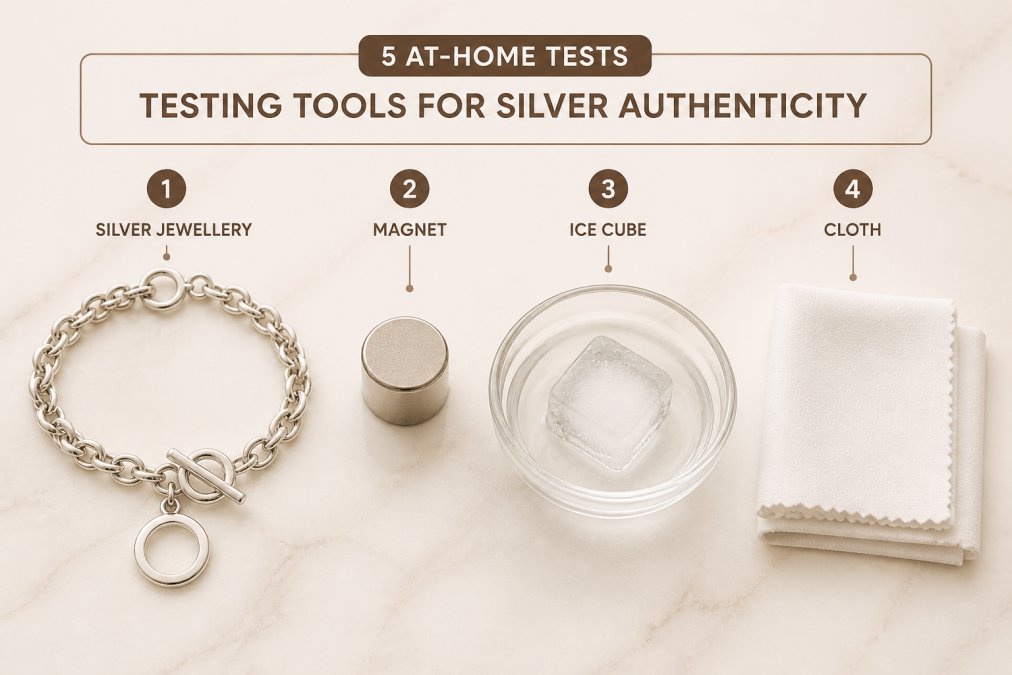
How to Tell If Silver Is Real: 5 At-Home Tests
Five tests, ranging from completely harmless to mildly risky. Run them in order; the first four are non-destructive.
Step 1: The Magnet Test
Silver is non-magnetic. Hold a strong neodymium magnet near the piece; real silver will show no attraction whatsoever. If the piece pulls toward the magnet, it contains iron, steel, or another ferromagnetic metal, and it is not solid silver.
This test eliminates fakes made from ferromagnetic metals, but it does not confirm silver. Copper, brass, aluminium, and lead are all non-magnetic too. Use this as a first filter, not a final verdict.
Step 2: The Ice Cube Test
Silver has the highest thermal conductivity of any common metal. Place an ice cube on a flat silver surface (a bar or large coin works best). Genuine silver will cause the ice to melt almost immediately, far faster than it would on glass or ceramic.
This test is most useful for silver bars and coins. It's less practical for delicate jewellery, where the surface area is too small to produce a clear result.
Step 3: The Ring (Sound) Test
Drop a silver coin onto a hard surface, or flick the edge of a silver bar with your fingernail. Genuine silver produces a clear, high-pitched ring, a sustained, bell-like tone that lingers. Base metals produce a dull thud or flat, short sound.
This is a classic numismatic test used by coin collectors for generations. For jewellery, the test is less definitive because the shape affects the sound significantly.
Step 4: The Tarnish and Oxidation Test
Rub the piece firmly with a clean white cloth. Real silver oxidises when exposed to air and skin oils, leaving a black or dark grey mark on the cloth. This is silver sulphide forming on the surface, the same process that causes tarnish on sterling silver jewellery over time.
No mark at all can indicate a heavily lacquered piece, a non-silver metal, or very thick silver plating. A yellow or orange mark suggests copper or brass beneath the surface.
Step 5: The Bleach Test
Apply a single drop of household bleach to an inconspicuous area of the piece. Real silver reacts with bleach almost immediately, turning black as silver chloride forms on the surface.
A piece that shows no reaction to bleach is likely not silver. A piece that turns black quickly almost certainly is.
Silver Purity Testing Methods: Destructive vs Non-Destructive
The five at-home tests above are all non-destructive or minimally so. When you need a definitive answer, particularly for high-value bullion or antique pieces, professional methods carry far more weight.
Non-destructive testing preserves the piece entirely. The magnet test, ice test, sound test, and tarnish test all fall here, as does XRF (X-ray fluorescence) analysis. These methods are appropriate for jewellery you intend to wear, coins with numismatic value, and any piece where condition matters.
Destructive testing involves removing material or applying chemicals that alter the surface. Acid testing and fire assay fall here. These methods are more precise but leave a mark or require a small sample. They're standard practice in refining and assay.
Acid Test Kits and Specific Gravity Testing
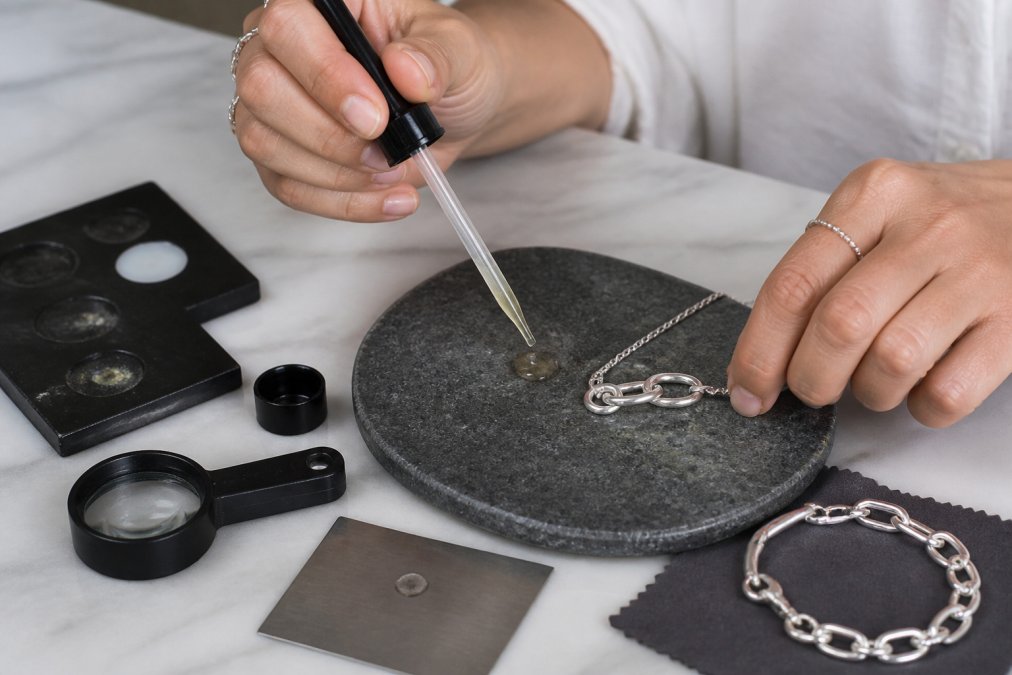
An acid test kit uses nitric acid solutions of varying concentrations to identify silver purity. You rub the piece on a black touchstone, apply a drop of acid to the mark, and observe the colour change. Different purities react differently: fine silver (999) behaves differently from sterling (925) or low-grade alloys.
According to guidance on precious metal testing from the London Assay Office, acid testing remains one of the most reliable field methods for distinguishing between silver purities when electronic testing is unavailable.
Specific gravity testing uses the density of the metal to identify it. Pure silver has a specific gravity of approximately 10.49 g/cm³. You weigh the piece in air, then weigh it submerged in water, and calculate the ratio. A result significantly below 10.49 suggests a lighter base metal or hollow construction.
Digital and Professional Testing Tools
XRF (X-ray fluorescence) analysers are the gold standard for non-destructive silver authentication. They fire X-rays at the surface and read the fluorescence signature, identifying the precise elemental composition of the metal, including whether a silver-plated piece has a different alloy beneath.
XRF devices are expensive, but many jewellers, pawnbrokers, and precious metal dealers own them. If you're buying a significant quantity of silver or a high-value piece, asking for an XRF reading is entirely reasonable.
Sigma Metalytics testers use electrical conductivity to verify precious metals non-destructively. They're designed specifically for coins and bars, and they can detect tungsten-core fakes, a type of counterfeit that passes the weight and density tests but fails on conductivity. For serious bullion collectors, this is the test that catches the fakes other methods miss.
Common Mistakes When Checking Silver Authenticity
Most testing errors come from over-relying on a single test.
Trusting the stamp alone. Hallmarks are reliable on pieces from reputable sources, but stamps can be faked on cheap imports. A 925 stamp on a piece with no other indicators of quality is not proof on its own.
Using a weak magnet. A standard fridge magnet lacks the field strength to test silver reliably. Only a neodymium magnet produces a clear result.
Confusing silver-plated with fake. Silver-plated items are not fraudulent; they're a legitimate product category. The problem arises when a seller represents a plated piece as solid sterling.
Applying the ring test to jewellery. The sound test works for coins and bars with regular geometry. A ring, bracelet, or pendant will produce an unreliable sound because the shape, thickness, and any attached stones all affect the resonance.
Skipping the hallmark check on antique pieces. Older silver, particularly Georgian and Victorian flatware, may carry hallmarks in unexpected locations or use date letters that look unfamiliar. The Victoria and Albert Museum's guide to silver hallmarks is an excellent reference for identifying antique British silver marks.
When buying new sterling silver jewellery, the simplest way to avoid uncertainty is to buy from a maker who is transparent about materials and sourcing. SilverStory's pieces, including the Silver Lunar Necklace and the Silver Chunky Chain Bracelet, are handcrafted in sterling silver by artisans in Rajasthan. When provenance is clear, testing becomes confirmation rather than investigation.

Buying silver should feel like a pleasure, not a risk assessment. The challenge is that the market mixes genuine sterling pieces with plated and base metal alternatives at every price point. SilverStory was built around the belief that quality and transparency go together: every piece in the collection is crafted in sterling silver, ethically sourced, and made to last. Browse the full collection, including the Silver Open Circle Ring and the Silver Interlinked Circle Necklace, and shop with the confidence that comes from knowing exactly what you're wearing.


Frequently Asked Questions
Can real silver be unmarked or missing a hallmark?
Yes, genuine sterling silver can occasionally be unmarked, particularly on very small or antique pieces where stamping was impractical. Under the Hallmarking Act 1973, silver items sold in the UK above a certain weight threshold must carry an assay office hallmark, but older or imported pieces sometimes lack one. An unmarked piece is not automatically fake, use additional tests such as the magnet test or ice cube test alongside a visual inspection to assess authenticity.
What is the significance of the 925 hallmark on silver jewellery?
The 925 stamp indicates that a piece contains 92.5% pure silver, with the remaining 7.5% typically being copper. This alloy is known as sterling silver and is the standard used in most fine jewellery. The number refers to parts per thousand of pure silver content. A genuine 925 stamp, especially when accompanied by an assay office mark from one of the four UK assay offices, is one of the most reliable indicators that a piece is real silver rather than silver-plated or a base metal substitute.
Does real silver tarnish differently than fake silver?
Real silver tarnishes through oxidation, developing a darkening patina that ranges from yellow to dark brown or black over time. This is a natural chemical reaction between the silver alloy and sulphur compounds in the air. Silver-plated items can also tarnish, but the plating often wears away unevenly, exposing a copper core or base metal underneath. If you notice green or brassy discolouration at worn edges or contact points, the piece is almost certainly plated rather than solid sterling silver.
How do you test real silver at home without damaging it?
The safest non-destructive methods are the magnet test, the ice cube test, and checking for hallmarks. Real silver is non-magnetic, so a strong magnet should not attract it. Silver also has exceptionally high thermal conductivity, so an ice cube placed on the surface melts noticeably faster than on most other metals. Checking for a 925 stamp or assay office mark costs nothing and leaves the piece undamaged. Avoid acid tests on finished jewellery unless you are comfortable with the risk of surface marking.
This article was written using GrandRanker