Gold Filled vs Gold Plated Jewelry: Durability Guide
Last Updated: October 22, 2026
Quick Summary
In gold filled vs gold plated jewelry, gold filled carries a thick, mechanically bonded gold layer that commonly lasts several years of regular wear, while gold plated carries a thin electroplated coating that typically shows visible wear within months to a couple of years. Layer thickness, not karat, predicts durability.
- A thick layer of lower-karat gold outlasts a thin layer of high-karat gold every time.
- Gold-filled rings and bracelets worn daily typically last several years, often longer with good care.
- Gold-plated rings worn daily usually show wear within months to around a year.
- Store gold filled chains flat or hanging rather than coiled so links do not rub together.
- Never use ultrasonic cleaners on plated pieces, and store them in an airtight bag with the clasp fastened.
Table of Contents
- Gold Filled vs Gold Plated Jewelry: What the Labels Really Mean
- Durability Compared: Tarnish, Fading and Wear-Through
- How Long Does Gold-Filled Jewellery Last?
- Gold-Filled Jewellery Care: Habits That Add Years
- Gold-Plated Jewellery Care: Protecting a Thinner Layer
- Gold-Filled vs Gold Vermeil: Where Vermeil Fits
- Spotting the Difference: Identification, Repair and Skin Sensitivity
- Frequently Asked Questions
Gold Filled vs Gold Plated Jewelry: What the Labels Really Mean
The gold filled vs gold plated distinction comes down to one thing: how much gold sits on the surface and how it got there.
At SilverStory, we handcraft gold-plated sterling silver pieces in Rajasthan, so we have a clear stake in explaining this honestly.

Gold plated is a jewellery construction where a very thin layer of gold is deposited onto a base metal through electroplating.
How each finish is made
Gold filled starts as a sandwich. A sheet of gold alloy is fused to a brass or copper core under heat and pressure, then rolled and drawn to thickness. The bond is mechanical, not chemical, and it does not peel away in normal use.
Gold plating works differently. The UK legislation on nickel release from jewellery matters here, because the base metal underneath is what your skin eventually meets once the coating thins.
Layer thickness: microns and karat explained
Thickness is measured in microns, and it is the number that predicts everything else.
- Gold filled: the gold layer is typically many times thicker than plating, and it is legally defined by weight fraction in several markets
- Gold plated: the gold layer is measured in fractions of a micron, often well under one micron on costume pieces
- Karat: 14k and 18k describe gold purity in the alloy, not thickness. A high karat does not rescue a thin layer
That is the theory. Here is where it gets practical: a thick layer of lower-karat gold outlasts a thin layer of high-karat gold every time.
Durability Compared: Tarnish, Fading and Wear-Through
Gold filled jewellery resists wear-through far better than gold plated jewellery because there is simply more gold to wear away. Plated pieces fail at the edges first, where friction concentrates.
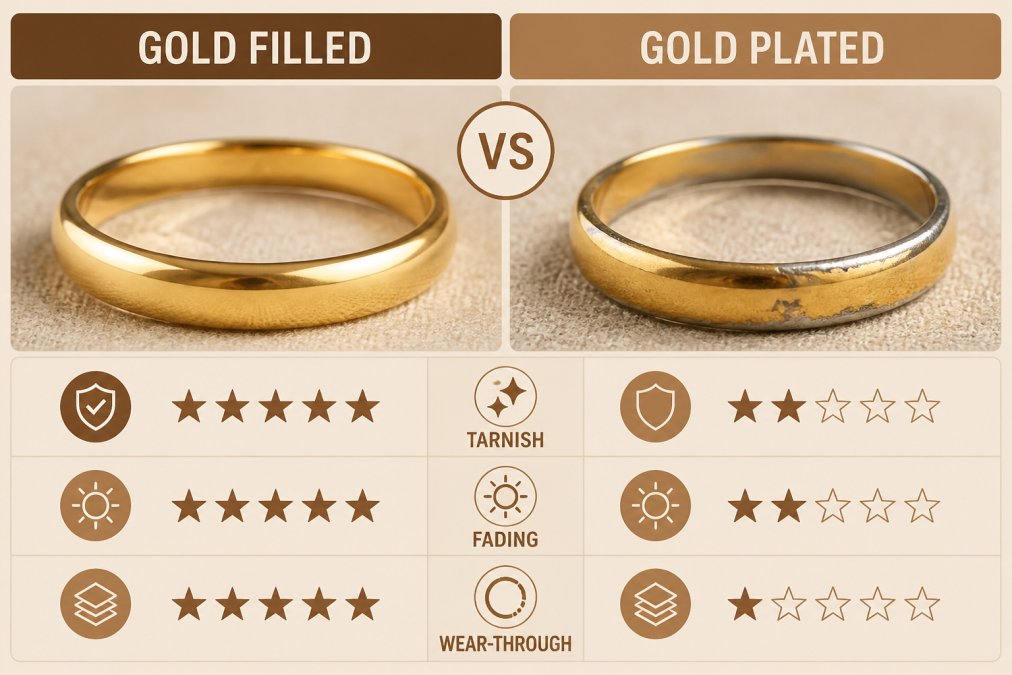
Tarnish is a separate issue from wear. Sterling silver and copper cores discolour when they meet moisture and sulphur compounds in the air. Gold itself does not tarnish, so the exposed core is what dulls.
Watch for these wear patterns:
- Fading on plated pieces, usually within months of daily wear
- Rubbing off at ring bands, bracelet clasps and necklace chains
- Scratches that cut through thin coatings and expose the base metal
How Long Does Gold-Filled Jewellery Last?
Gold-filled jewellery commonly lasts several years of regular wear, and often considerably longer with good care. Gold-plated jewellery typically shows visible wear within months to a couple of years, depending on the thickness of the coating and how often it is worn. Those ranges are honest, but they are also broad enough to be unhelpful on their own. The useful question is not "how long does gold filled last" but "how long will this piece last given how I wear it."
Why a single lifespan figure misleads
A necklace worn twice a week and a ring worn every day are not the same product, even if they carry the same construction label. Friction, sweat, and abrasion load vary enormously by jewellery type, so any single number quoted for "gold filled" or "gold plated" is an average that fits almost nothing. Treat manufacturer claims of "years of wear" as best-case scenarios under light use, and treat the ranges below as realistic outcomes for everyday wear.
Realistic lifespan by jewellery type
| Jewellery type | Gold filled (everyday wear) | Gold plated (everyday wear) | Why |
|---|---|---|---|
| Ring | Several years, often longer | Months to around a year | Constant friction against skin, surfaces and other objects |
| Bracelet | Several years | Months to a year | Clasps and links rub continuously; wrists contact desks and sleeves |
| Necklace | Several years and up | A year or more with care | Less direct friction, but chains rub at the clasp and pendant bail |
| Earring | Several years | A year or more | Low friction, but sweat and hair products collect at the post |
These are ranges, not guarantees. A gold-filled ring worn daily and never removed will still eventually show wear at the band; a gold-plated necklace worn only for occasions can last years. The construction sets the ceiling; your habits decide how close you get to it.
The factors that actually move the number
- Layer thickness. More gold means more time before the core shows. Gold filled carries a layer many times thicker than plating, which is why it sits in a different lifespan bracket entirely.
- Wear frequency and friction. Daily wear on a ring beats a necklace worn twice a week. Friction concentrates at edges, clasps and bands.
- Body chemistry. Sweat acidity and skin oils vary between people and speed up or slow down deterioration. Some wearers see plating dull within weeks; others get a year or more from the same piece.
- Exposure. Perfume, chlorine, cleaning products and abrasive surfaces all shorten life. Repeated exposure to chlorinated water is particularly hard on thin coatings.
- Care. Wiping after wear and storing dry and separately measurably extends the useful life of both constructions.
We would rather give you a range than a promise, because anyone quoting a single figure for every piece is guessing.
Gold-Filled Jewellery Care: Habits That Add Years
Gold-filled jewellery care is mostly about removing it at the right moments. The gold layer is thick, but it is not indestructible.
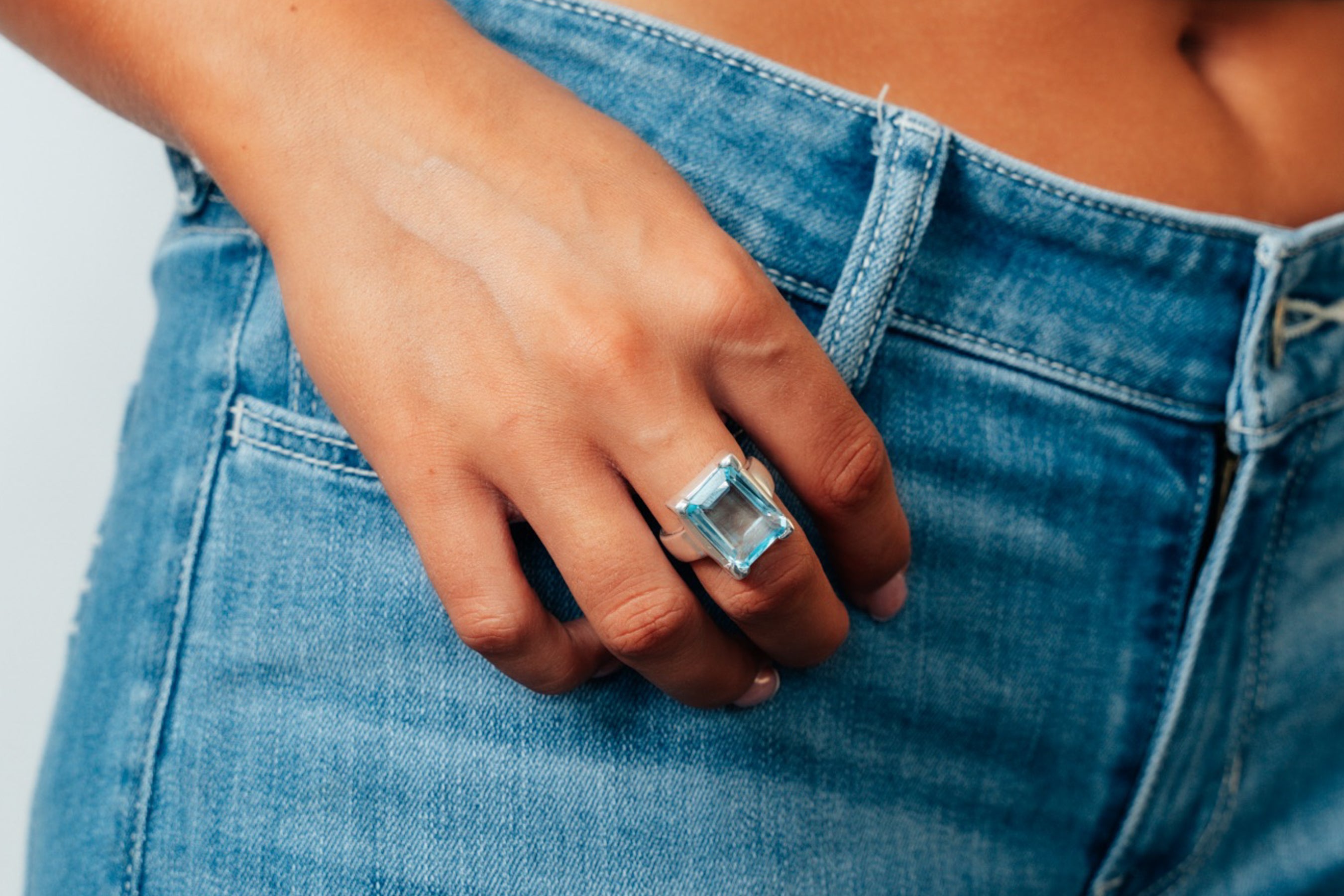
Gold Rectangular Amethyst Ring →
- Take pieces off before swimming, showering and heavy exercise
- Apply perfume and moisturiser first, then put jewellery on
- Wipe with a soft dry cloth after wear to remove sweat and oils
Avoid abrasive polishes. They remove a microscopic layer of metal each time, and on a gold filled piece that is gold you are polishing away.
Gold-Plated Jewellery Care: Protecting a Thinner Layer
Gold-plated jewellery care follows the same principles but with less margin for error. The coating is thin, so every exposure counts.
The habits that matter most:
- Put plated pieces on last and take them off first
- Keep them away from water, sweat and household cleaners
- Never use ultrasonic cleaners on plated pieces
Expect to retire a heavily worn plated piece eventually. That is not a fault, it is the nature of a thin coating. [Our Gold Crystal Ring at £35 and](/products/gold-gemstone-ring) Gold Interlinked Circle Necklace at £55 are plated sterling silver, and we would rather you knew how to look after them than be surprised.

Gold-Filled vs Gold Vermeil: Where Vermeil Fits
Gold vermeil sits between the two. Vermeil is sterling silver with a gold plating that meets a minimum thickness standard, usually stated in microns, and it must be gold over silver rather than over brass.
| Construction | Base Metal | Gold Layer | Typical Lifespan | Best For |
|---|---|---|---|---|
| Gold filled | Brass or copper | Thick, mechanically bonded | Several years and up | Daily-wear rings and bracelets |
| Gold vermeil | Sterling silver | Thicker plating, regulated minimum | A few years with care | Sensitive skin, statement pieces |
| Gold plated | Brass, copper or silver | Thin electroplated coating | Months to a couple of years | Occasional wear, gifting |
Vermeil beats standard plating on thickness and on skin sensitivity, because the silver core is gentler than brass. It still does not match gold filled for pure abrasion resistance.
Spotting the Difference: Identification, Repair and Skin Sensitivity
Reading stamps and labels
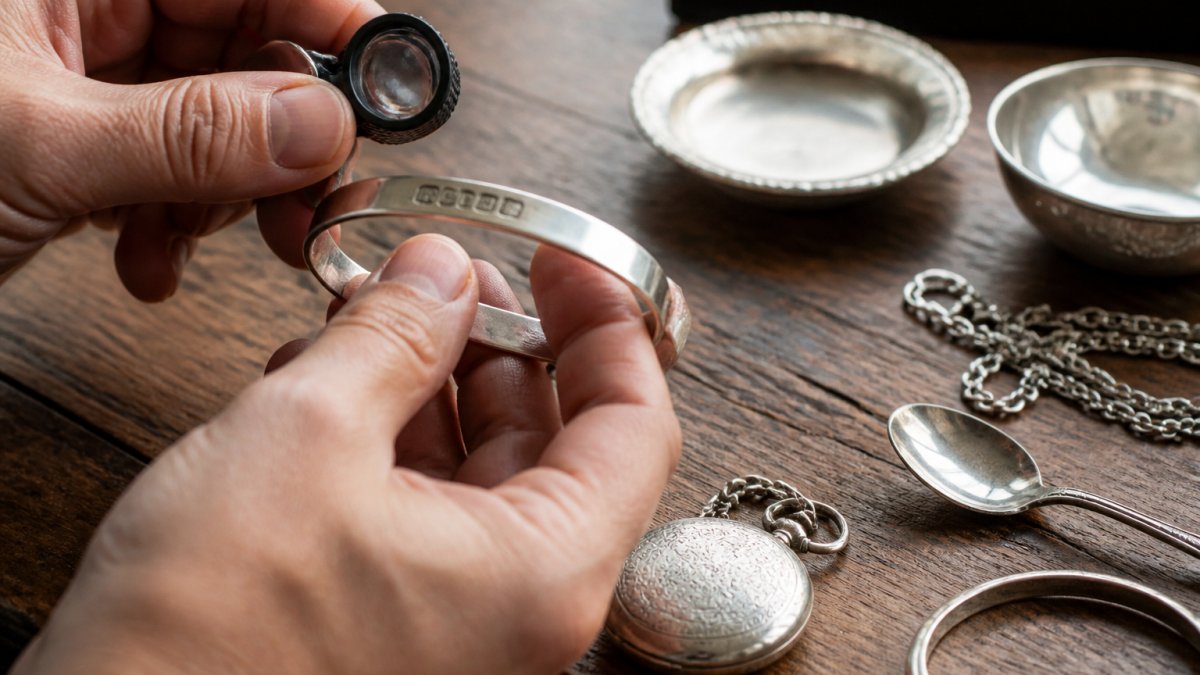
Check the stamp first, but treat it as a starting point rather than proof. Gold-filled pieces are usually marked "GF" or with a fraction such as "1/20 14K GF", which states the gold layer is one-twentieth of the total weight by law in markets that regulate the term. Plated pieces may carry no construction mark at all, or say "gold plated" or "GP".
A safe verification checklist:
- Read the product description for the words "gold filled" or "gold plated" and for a stated layer thickness in microns. Vague terms such as "gold tone" or "gold finish" usually mean plating.
- Look at the edges under bright light for a colour change where the base metal shows through.
- Check the weight. Gold filled pieces are denser than plated pieces of the same size because the gold layer is a substantial fraction of the mass.
Repair, replating and end-of-life
Repair options differ by construction. Gold-filled pieces can often be re-polished and re-finished, and because the gold layer is thick, light polishing does not immediately expose the core. Plated pieces can be replated, but the cost frequently exceeds the value of the piece, particularly for lower-priced items.
End-of-life recycling recovers the metal either way. Gold-filled pieces carry more recoverable gold by weight, which is one reason they hold a little more residual value.
Skin sensitivity and metal exposure
On skin sensitivity, the base metal is the risk, not the gold. Nickel in plated costume jewellery is a common irritant, and NHS guidance on nickel allergy sets out the symptoms to watch for. Gold-filled and vermeil pieces reduce exposure because the gold layer lasts longer before the core is revealed, but neither category is universally hypoallergenic, a wearer with a nickel allergy can still react once wear-through occurs.
[Our Gold Lunar Necklace at £79 and](/products/gold-moon-and-disc-necklace) Gold Chunky Chain Bracelet at £75 are gold-plated sterling silver, handcrafted in Rajasthan. We describe them honestly as plated, and we price them accordingly.

Frequently Asked Questions
Does gold-filled jewellery last longer than gold-plated jewellery?
Yes, in normal conditions. Gold-filled pieces carry a bonded gold layer that is a far higher fraction of the total metal weight than the thin electroplated coating on gold-plated jewellery. That extra thickness means the gold takes much longer to wear through at high-friction points such as ring bands, clasp edges and bracelet links. Gold-plated pieces can look identical on day one, but the coating is measured in fractions of a micron, so repeated rubbing, moisture and skin oils expose the base metal sooner. Neither finish is permanent, but gold-filled generally holds its colour for years rather than months.
How long does gold-filled jewellery last with everyday wear?
There is no single number, because lifespan depends on the piece and how it is worn. A gold-filled pendant or pair of earrings that rarely rubs against anything can keep its finish for many years. A gold-filled ring or bracelet, which faces constant friction, will show wear sooner. Factors that shorten life include chlorine, perfume, abrasive cleaners, tight fit and sleeping in the piece. Removing jewellery before showers, swimming and workouts, and storing it dry and separate, is the simplest way to extend how long gold-filled jewellery lasts.
Can gold-plated jewellery get wet?
Occasional light contact with water is not fatal, but repeated soaking is what shortens the life of gold-plated jewellery. Showering, swimming and washing up expose the thin gold coating to moisture, soap and chlorine, and the water trapped against the skin speeds up tarnish and lifting at the edges. Pat the piece dry immediately if it does get wet, and keep it away from pools, hot tubs and household cleaning products. Following consistent gold-plated jewellery care, including drying after wear and storing in a pouch, keeps the colour looking even for longer.
How can you tell gold-filled jewellery from gold-plated jewellery?
Check the stamp first. Gold-filled pieces are usually marked with a fraction and karat, such as 1/20 12K GF, which states how much of the item's weight is gold and at what purity. Gold-plated pieces are typically marked GP, gold plated or gold tone, often with no fraction at all. Look at edges and high-friction points under good light: a plated piece often shows a duller base metal at worn corners. Ask the seller for the layer thickness in microns, since a supplier who can quote it usually has documentation behind the claim.