
Questions to Ask About Diamond Origin
Table of Contents
- Why Diamond Origin Matters
- Understanding Diamond Provenance and Where It Comes From
- Essential Questions to Ask Your Jeweller About Diamond Origin
- How to Verify a Diamond's Origin Through Certification
- Ethical Diamond Sourcing: Questions About Responsible Production
- Your Origin Verification Checklist
- Frequently Asked Questions
Last Updated: October 15, 2026
Why Diamond Origin Matters
Where a diamond comes from shapes your purchasing decision, the value you receive, and your values as a conscious consumer.
Origin influences price, ethical credentials, and how you feel wearing it. A responsibly mined diamond differs fundamentally from one with an unclear supply chain, and lab-grown stones offer a different proposition than natural ones.
This guide covers the essential questions to ask about diamond origin, how to verify claims, what certificates actually prove, and how to choose in line with your values.
Understanding Diamond Provenance and Where It Comes From
Diamond provenance is the documented history of where a diamond came from and how it moved through the supply chain, the chain of custody from mine to your hand. Clear provenance tells you something concrete; its absence leaves questions unanswered.
Natural versus lab-grown diamonds
Natural diamonds form over billions of years deep within the Earth and are mined as a finite resource. Lab-grown diamonds are created in laboratories within weeks.
The key difference isn't quality, lab-grown diamonds are real diamonds. It's how they formed and where they came from.
For questions to ask about diamond origin, this distinction is the starting point: know which type you're buying before asking anything else.
How lab-grown diamonds are made
Lab-grown diamonds use one of two methods: High Pressure High Temperature (HPHT) or Chemical Vapor Deposition (CVD).
In HPHT, scientists place carbon in a press and apply extreme heat and pressure, recreating conditions deep in the Earth; a diamond forms within weeks.
Both methods produce real diamonds through a repeatable, controlled process, so lab-grown stones have consistent quality and a traceable origin, made in a specific facility on a specific date.
Essential Questions to Ask Your Jeweller About Diamond Origin
These questions separate informed buyers from those who simply accept what they're told. Ask them directly, a reputable jeweller will have clear answers.
Question 1: Is this a natural or lab-grown diamond?
This is the foundation question: natural or lab-grown? A reputable jeweller answers immediately and explains their recommendation. Evasiveness is a red flag.
Natural diamonds come from the Earth; lab-grown diamonds come from a laboratory. Both are real, but the distinction matters for questions to ask about diamond origin because verification differs.
Question 2: Can you document the chain of custody?
Chain of custody means the documented path your diamond took from its source to the jeweller to you.
For natural diamonds, chain of custody is harder to establish: stones pass through many hands, and not every link keeps detailed records.
Ask: "Can you show me where this diamond came from? Do you have documentation from your supplier?" A good answer includes names, dates, and supplier information; a vague one suggests the jeweller doesn't know the origin either.
Question 3: Does the diamond have a laser inscription?
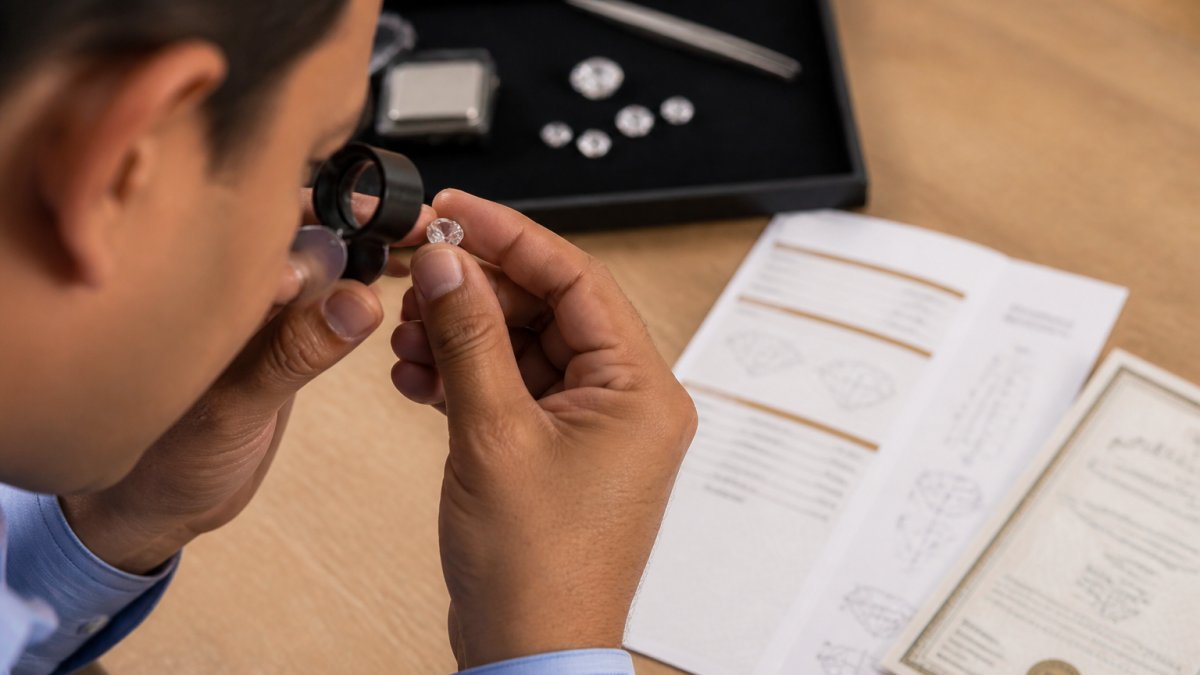
Many diamonds carry a laser inscription, a microscopic identification number etched onto the surface, invisible to the naked eye but visible under magnification. It acts as a fingerprint linking the physical diamond to its grading report, creating accountability and traceability.
Ask: "Does this diamond have a laser inscription? What is the number?" Then verify it matches the grading report, one concrete way to confirm the stone you're examining is the one described in the certificate.
Question 4: What does the grading report actually tell us?
A grading report, issued by an independent gemological laboratory, documents the 4Cs: cut, color, clarity, and carat weight. It tells you the diamond's quality and specifications, not where it came from, whether it was mined responsibly, or whether it's conflict-free.
This is crucial for questions to ask about diamond origin: a grading report covers the stone itself, not its history. Many buyers mistake it for proof of ethical sourcing or geographic origin. Ask your jeweller: "What does this certificate actually verify?
How to Verify a Diamond's Origin Through Certification
Certification and origin verification are different things. Knowing what to check, in what order, and what each document can and cannot prove is essential.
What a diamond certificate origin section shows
Some certificates include an "origin" field. For natural diamonds it typically states "natural" but rarely names a country or mine, often "country of origin: unknown" because the stone passed through multiple suppliers. For lab-grown diamonds it's more informative, naming the laboratory and method (HPHT or CVD).
Lab-grown diamonds have verifiable origins because they were made in a specific place; natural diamonds often don't, because supply chains are complex and records aren't always kept. Ask your jeweller: "What does the origin section actually say?
What certificates can and cannot prove about geographic origin
A grading report is an identity and quality document: it confirms the stone described is the stone in front of you and records the 4Cs. It does not, on its own, prove where a natural diamond was mined.
Supplier documentation claiming a specific origin can be falsified or misrepresented as it moves through the supply chain. That's why questions to ask about diamond origin focus on chain of custody and seller transparency rather than what a certificate can prove: the certificate tells you about the stone, the seller's transparency tells you about the origin claim.
A practical, step-by-step origin verification checklist
Use this sequence when you're shown a diamond. It works for natural and lab-grown stones, though answers differ.
- Confirm the diamond type. Ask directly: natural or lab-grown? Get a clear answer before anything else.
- Ask for the grading report. Check that it comes from an independent laboratory and that the report number matches the stone.
- Verify the laser inscription. Ask the jeweller to show you the inscription under magnification. Confirm the number matches the grading report. This links the physical stone to the paperwork.
- Read the origin field. Ask what it says. For lab-grown, expect a facility and method. For natural, expect "natural" or "unknown" rather than a country.
- Ask for chain-of-custody documentation. Request supplier names, invoices, or provenance records. A reputable jeweller will have some of this; a vague answer is a warning sign.
- Ask what the documentation does not prove. A good jeweller will be honest about the limits. If they claim a certificate proves geographic origin, treat that as a red flag.
- Cross-check any origin claim. If a specific country or mine is claimed, ask how that claim was verified and whether it appears on the grading report or only on supplier paperwork.
- Decide whether the level of documentation meets your comfort threshold. If it does not, ask for more or walk away.
The limits of origin documentation
Many buyers don't realize a certificate can't prove geographic origin for most natural diamonds; even an origin field is often based on supplier declarations rather than independent testing.
If a seller can't or won't provide that evidence, ask what they can provide, give them a chance to follow up, then decide whether the uncertainty is acceptable. Many buyers find lab-grown diamonds, with clearer production records, offer a more straightforward origin story; others prefer natural stones and accept partial provenance.
Ethical Diamond Sourcing: Questions About Responsible Production
Ethical sourcing and geographic origin are related but different: a diamond can come from a specific country and still be unethically sourced, or be lab-grown and ethically produced. What matters is how claims are substantiated, not the label applied.
Conflict-free claims and responsible sourcing standards
Conflict-free means the diamond wasn't mined in a war zone or used to finance armed conflict, a baseline standard, not a comprehensive ethical certification. Responsible sourcing goes further, covering labour practices, environmental impact, and community benefit.
For lab-grown diamonds, ask about the laboratory's energy sources, labour standards, and waste management. Some labs publish sustainability reports; others don't.
What to do when a seller cannot document origin
If a jeweller can't clearly answer your questions to ask about diamond origin, you have options.
First, ask them to find out. Give them time to contact their supplier and set a reasonable deadline.
Third, consider independent verification. For lab-grown diamonds, the producing laboratory can sometimes confirm origin from the certificate number.
Sixth, walk away if the answers don't come. Evasiveness or an inability to explain their own paperwork is information.
Questions that reveal how much a seller really knows
Some questions can't be answered with a script. Try these:
- "Which specific standard does this diamond meet, and who audited it?"
- "What does that standard not cover?"
- "Can you show me the supplier documentation for this stone?"
- "If I wanted to verify the origin claim independently, how would I do that?"
- "What happens if the origin claim turns out to be wrong?"
A seller who can answer these likely knows their supply chain. One who can't may still be honest, but can't substantiate what they're selling, and that distinction is the whole point of asking about diamond origin.
Your Origin Verification Checklist
Use this checklist when evaluating any diamond purchase:
- Jeweller clearly states: natural or lab-grown?
- Jeweller provides grading report from independent laboratory
- Laser inscription number on diamond matches certificate number
- Jeweller explains what the certificate does and doesn't verify
- Jeweller provides supplier information or chain of custody documentation
- For natural diamonds: jeweller explains the limits of origin claims
- For lab-grown diamonds: jeweller names the laboratory and production method
- Jeweller answers questions about ethical sourcing standards
- Jeweller is transparent about what they don't know
- You feel confident in the jeweller's knowledge and honesty
If any item on this checklist remains unanswered, that's information you need before making your purchase.
Asking questions to ask about diamond origin isn't just practical, it's part of making a choice you feel good about.
At SilverStory, we apply this same philosophy to all our jewellery. Each piece is handcrafted by skilled artisans in Rajasthan, ensuring a unique and beautiful addition to your collection.
Frequently Asked Questions
What does diamond origin mean?
Diamond origin refers to where and how a diamond was formed. It encompasses whether the diamond is natural (mined from the earth) or lab-grown (created in a laboratory), and ideally, the geographic location of its source. Origin also connects to provenance, which traces the diamond's journey from production through to you. Understanding origin helps you verify ethical sourcing and make informed purchasing decisions aligned with your values.
How can I verify a diamond's origin?
Request a grading report from an independent gemological laboratory, which documents whether the diamond is natural or lab-grown. Ask your jeweller for documentation of the chain of custody, showing the diamond's journey from source to sale. Check for a laser inscription on the diamond's girdle that matches the report number. Ask direct questions about sourcing, responsible practices, and conflict-free status. If the seller cannot provide clear documentation, that is a red flag worth investigating further before purchase.
Can a diamond certificate show where it was mined?
Most standard diamond certificates do not identify the specific country or mine of origin. They confirm whether the diamond is natural or lab-grown, and provide the 4Cs (cut, colour, clarity, carat weight) and other quality details, but geographic origin is rarely included. Some premium certification services and ethical sourcing initiatives offer additional provenance documentation, but this requires specific request and often higher cost. Always ask your jeweller whether enhanced origin documentation is available for your diamond.
What makes a diamond ethically sourced?
Ethical diamond sourcing means the diamond was produced without fuelling conflict, with fair labour practices, and ideally with environmental responsibility. For natural diamonds, this involves conflict-free certification and responsible mining standards. For lab-grown diamonds, ethical sourcing focuses on the energy used in production and labour conditions. Ask your jeweller about their sourcing standards, certifications they hold, and how they verify ethical claims. Transparent sellers should be able to explain their supply chain and responsible sourcing commitments clearly.